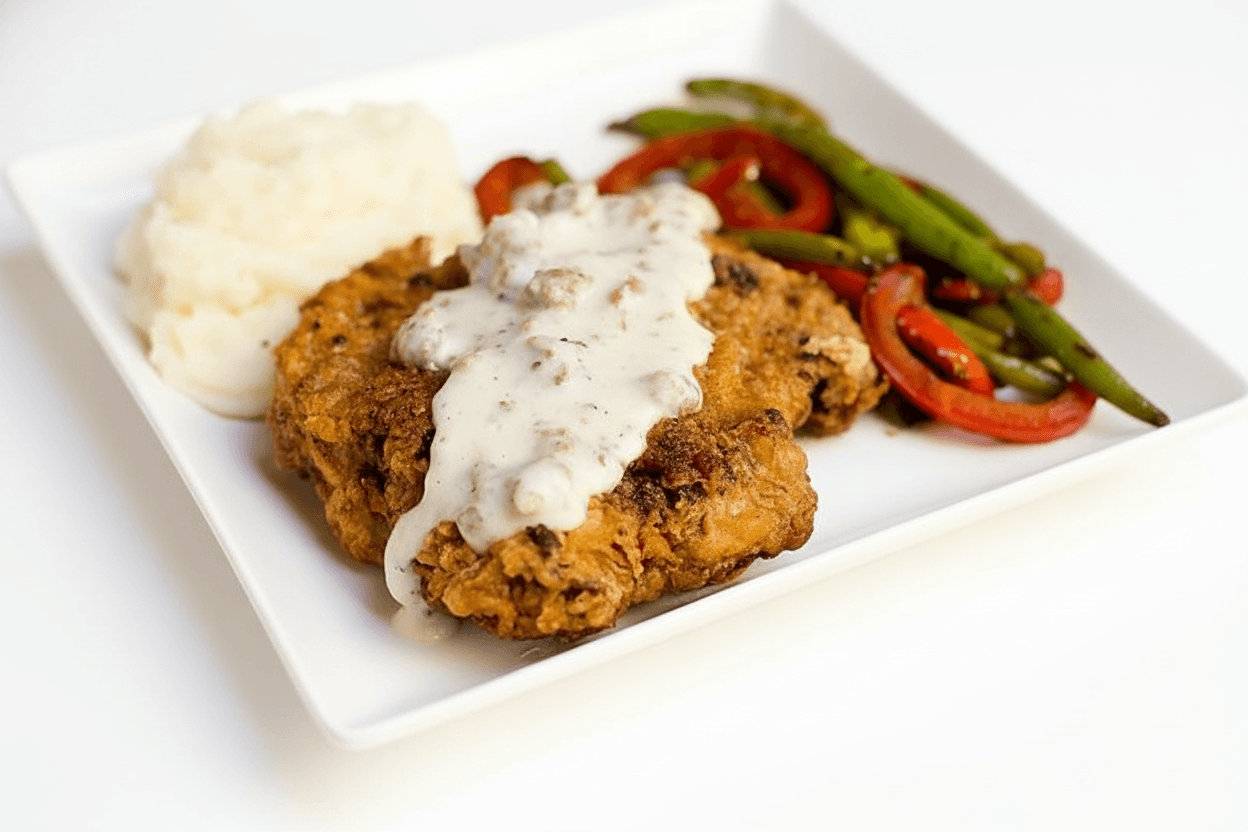
Country Fried Steak with Pan-Dripping Sausage Gravy
All-Day Breakfast
This is the undisputed heavyweight champion of the all-night diner counter—a humble, brutalized cut of beef elevated through the unpretentious alchemy of hot fat and seasoned flour. It is a masterclass in short-order timing, utilizing a heavy cast-iron skillet to violently fry the steak, then using those exact pan drippings as the architectural foundation for a fiercely peppery sausage gravy. No commercial deep fryers here, just a roaring skillet, a heavy hand with the black pepper, and the kind of meal that makes you deeply thankful for the great American roadside.
Before you start
Thoroughly dry the meat.
Place the cube steaks between paper towels and firmly press out all surface moisture. A dry steak is mandatory for a crispy crust.
Preheat your oven to 200°F.
Set a clean wire cooling rack over a baking sheet inside the oven. This will act as your holding station for the finished steaks.
Ingredients
- beef cube steak1 1/2 lb
- all-purpose flour1 3/4 cup
- kosher salt1 tbsp
- coarse ground black pepper2 1/2 tsp
- garlic powder1 tsp
- onion powder1 tsp
- cayenne pepper1/2 tsp
- buttermilk3/4 cup
- eggs2 large
- hot sauce1 dash
- vegetable oil3/4 cup
- bacon drippings1 tbsp
- bulk pork breakfast sausage1/2 lb
- whole milk3 cup
Method
- 01
Set up the breading station using two wide, shallow dishes.
In the first dish, whisk together 1 1/2 cups of the flour, the kosher salt, 1 1/2 teaspoons of the black pepper, garlic powder, onion powder, and cayenne. In the second dish, whisk the buttermilk, eggs, and hot sauce until completely smooth.
- 02
Double-dredge the steaks to build a thick, shaggy crust.
Press each steak into the seasoned flour, coat it entirely in the wet wash, and then return it to the flour, pressing forcefully with the heel of your hand to fuse the breading to the meat.
- 03
Let the breaded steaks rest on a wire rack for 15 minutes.
This hydration period is absolutely critical; it allows the dry flour to absorb the egg and buttermilk, transforming into a paste that bonds to the meat so the crust survives the fry.
- 04
Heat the vegetable oil and bacon drippings in a large cast-iron skillet over medium-high heat until it reaches 350°F.
You want the fat about 1/4-inch deep. Test the oil by dropping a pinch of flour into the pan; if it aggressively sizzles and pops, you are ready to fry.
- 05
Fry the steaks without touching them for 3 to 4 minutes per side.
Carefully lay the meat into the hot oil, dropping it away from you to prevent splashing. Let the cast iron do its work until the bottom is a dark golden brown and blood begins to pool slightly on the top, then flip with tongs and finish frying. Move the cooked steaks to your 200°F oven to hold.
- 06
Pour off the excess frying oil but retain exactly 2 to 3 tablespoons of fat along with all the toasted crunchies.
Do not wipe the skillet clean. These caramelized bits of beef fat and toasted breading are the lifeblood of your gravy.
- 07
Reduce the heat to medium and brown the bulk sausage directly in the retained fat.
As the pork renders its fat, use a flat metal spatula to perform the short-order scrape, digging up the beefy fond from the steaks and incorporating it directly into the sausage.
- 08
Sprinkle the remaining 1/4 cup of flour over the browned sausage and stir vigorously.
Cook this greasy paste for 1 to 2 minutes, stirring constantly, to toast the raw flour taste away until it smells nutty and savory.
- 09
Slowly pour in the whole milk while whisking constantly to emulsify the gravy.
Bring the mixture to a gentle simmer, then reduce the heat to low and let it simmer for 3 to 5 minutes until it is thick enough to coat the back of a spoon. Season aggressively with the remaining 1 teaspoon of black pepper.
- 10
Serve the warm steak smothered in a generous ladle of hot sausage gravy.
Leave the crispy edges of the steak peeking out, and serve immediately alongside sunny-side-up eggs and a pile of crispy hash browns.
Notes
Pacing is the secret to short-order cooking.
A diner cook manages multiple components simultaneously. Use your 200°F oven to hold the fried steaks perfectly warm and crispy on a wire rack while you construct the gravy in the dirty cast-iron skillet.
Consider swapping half the black pepper for white pepper.
While coarse black pepper is standard, many classic diners rely on ground white pepper in their gravy for a smoother aesthetic and a distinct, sharp, earthy heat.
From Cook Diner Food at Home.