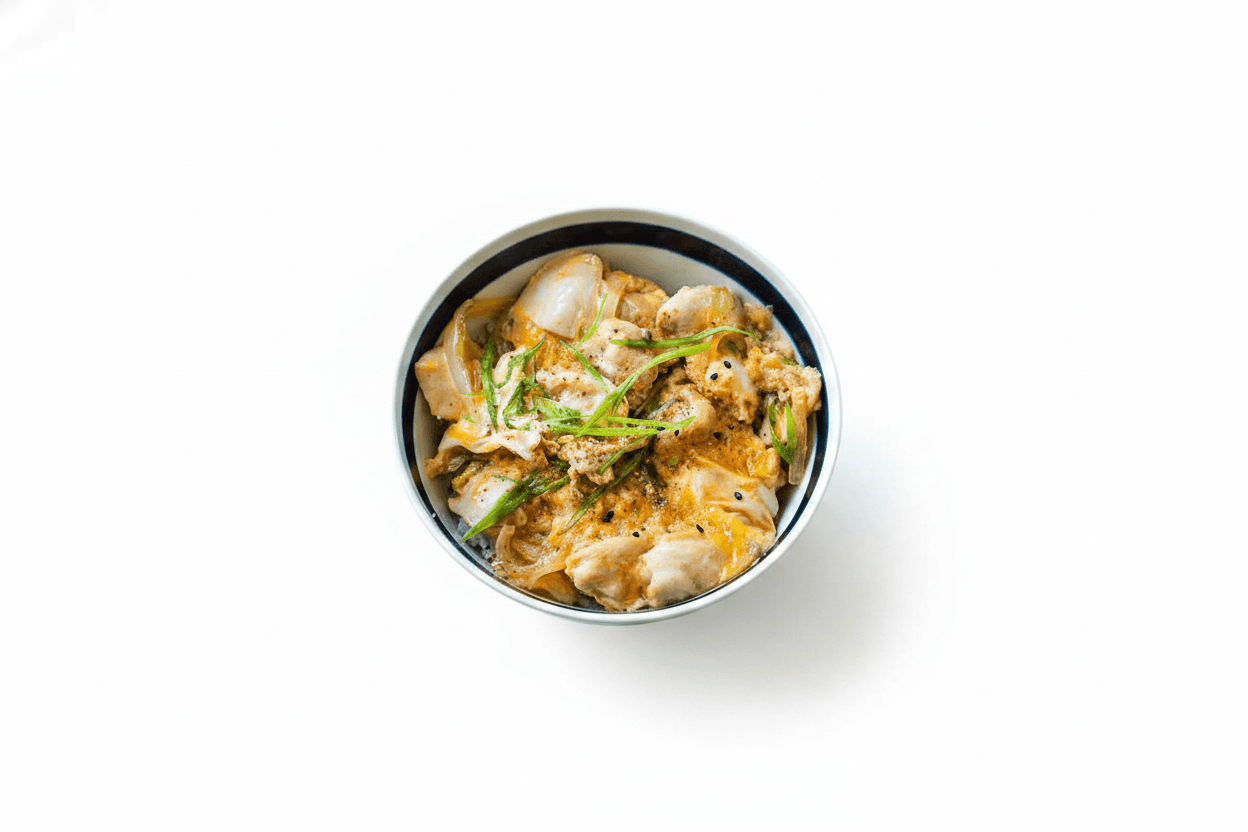
Classic Oyakodon
親子丼·(oh-yah-koh-dohn)
One-Bowl Donburi & Noodle Fixes
Oyakodon translates poetically to 'parent and child bowl,' a nod to the chicken and egg that make up this foundational Japanese comfort food. This is the ultimate weeknight fix—the exact meal a Tokyo grandmother whips up when you arrive tired and hungry. Forget the over-scrambled, aggressively sweet Americanized restaurant versions. The secret to that elusive, deeply savory fuwatoro (fluffy and creamy) texture relies entirely on a golden ratio of broth and a two-stage egg pour. It is fast, it relies on cheap pantry staples, and it tastes exactly like home.
Before you start
Prepare the chicken for maximum flavor absorption.
Trim any excess fat from the chicken thighs and slice them diagonally. This Japanese technique, sogigiri, helps the meat cook faster and soak up the umami of the broth. Toss the pieces with the sake and set aside to tenderize.
Gently break the eggs without fully homogenizing them.
Crack the eggs into a bowl. Using chopsticks, gently break the yolks and pull the whites through a few times. Stop before the egg becomes a uniform yellow. You want distinct streaks of yolk and white to achieve the proper fluffy texture later.
Ingredients
- hot cooked Japanese short-grain rice2 cup
- boneless chicken thighs1/2 lb
- yellow onion1/2 med
- eggs3 large
- scallions2 med
- dashi broth1/2 cup
- soy sauce2 tbsp
- mirin2 tbsp
- sugar1 tbsp
- sake1 tbsp
Method
- 01
Simmer the golden ratio broth.
In a small non-stick skillet over medium heat, combine the dashi, soy sauce, mirin, and sugar. Stir gently until the sugar completely dissolves.
- 02
Cook the chicken and onions.
Add the sliced onions in an even layer across the skillet, then lay the chicken pieces on top. Bring the liquid to a gentle simmer, lower the heat to medium-low, and cook uncovered for 4 to 5 minutes, flipping the chicken halfway. Stop when the onions are soft and the meat is fully cooked.
- 03
Establish the base with a first stage egg pour.
Ensure the broth is gently bubbling. Drizzle two-thirds of the beaten egg evenly over the chicken and onions. Do not stir it. Cover the skillet with a lid and let it simmer for exactly 1 minute until this first layer is mostly set, binding the meat and onions together.
- 04
Create the sauce with a second stage egg pour off the heat.
Remove the lid, scatter the sliced scallions over the top, and drizzle the remaining one-third of the raw egg into the empty spaces around the edges. Immediately turn off the heat and cover the pan again. Let it sit undisturbed for 30 to 60 seconds. The residual heat gently steams the top layer into a glossy, creamy custard.
- 05
Serve immediately over hot rice.
Uncover the skillet. Scoop hot steamed rice into two deep bowls. Carefully slide the chicken, egg, and all of the rich, savory broth directly out of the pan and over the rice. Eat it while it's piping hot.
Notes
Pan size matters.
An 8-inch non-stick skillet is perfectly sized for one or two servings, ensuring the broth stays deep enough to poach the chicken rather than evaporating. Do not attempt to make four servings in a massive pan; the liquid-to-egg ratio will fail.
Instant dashi is completely authentic.
Don't feel pressured to make dashi from scratch on a Tuesday night. High-quality instant dashi powder dissolved in warm water is exactly what most modern Japanese home cooks use, and it tastes brilliant.
From Cook Japanese in America.