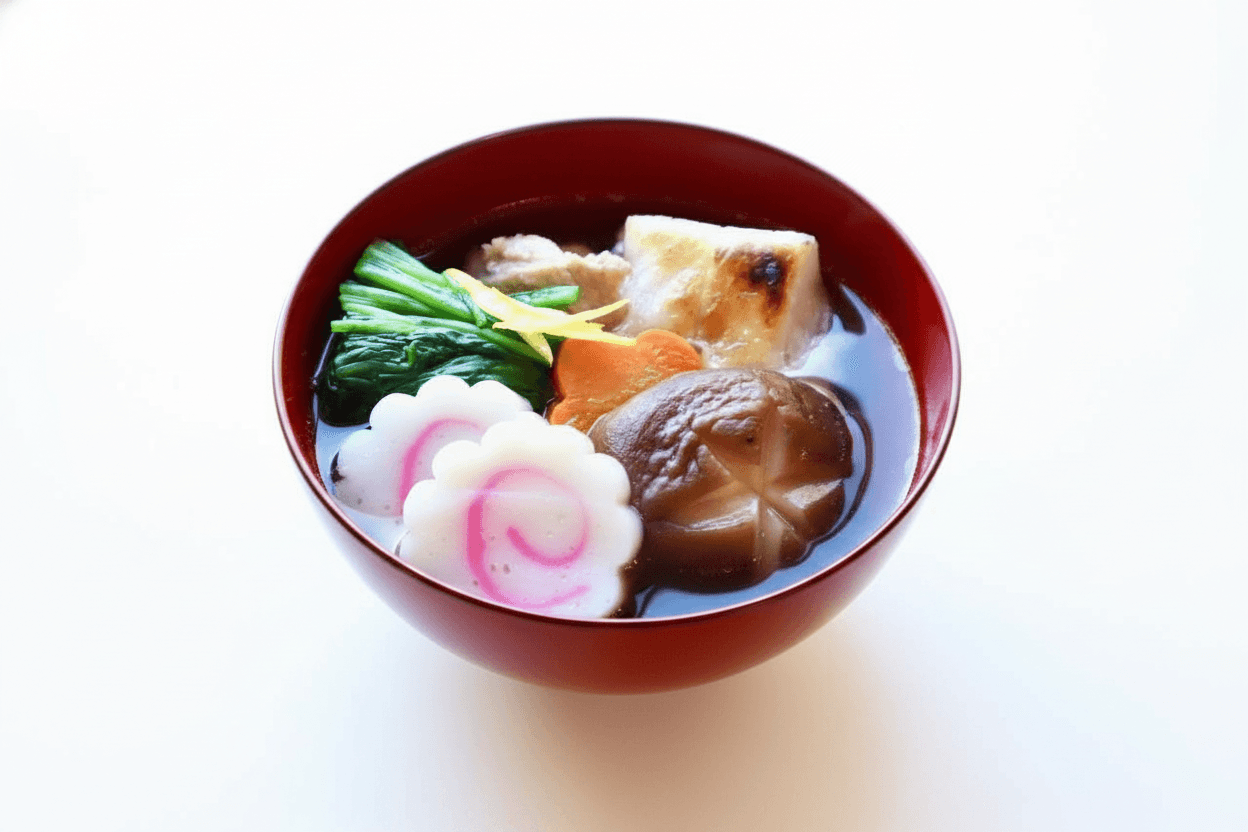
Classic Nikkei Ozoni
お雑煮·(o-zō-ni)
The Nikkei Heritage Table: Potlucks & Holidays
For the Japanese-American diaspora, New Year's Day is anchored by the smell of toasted mochi and the rich, savory steam rising from a bowl of clear-broth ozoni. This is the canonical Kanto-style soup that sustained generations of Nikkei families in the Midwest and on the coasts, relying entirely on the fundamental, harmonious umami of dashi and soy sauce. It is a masterclass in making a few simple, accessible ingredients taste like absolute magic. The secret from grandma's kitchen is simple: toast the mochi until it puffs dramatically, meticulously skim the broth, and never skip the tiny sliver of citrus peel at the end.
Before you start
Blanch the spinach to protect the broth.
Bring a small pot of water to a boil, drop in the spinach for 30 seconds, then immediately shock it in a bowl of ice water. Squeeze out all excess water, form into a tight log, and cut into 2-inch lengths. Boiling the spinach separately prevents the soup from turning a muddy green color.
Parboil the root vegetables.
In the same boiling water, add the sliced carrots and daikon. Boil for 2 to 3 minutes until they are just tender enough to be pierced with a fork, then drain and set aside.
Ingredients
- water4 cup
- dried kombu1 med
- katsuobushi15 g
- soy sauce1 tbsp
- sake1 tbsp
- mirin1 tsp
- kosher salt1/2 tsp
- boneless skinless chicken thighs1/2 lb
- kirimochi4 med
- daikon radish2 med
- carrot1/2 med
- dried shiitake mushrooms2 med
- fresh spinach4 oz
- kamaboko4 small
- lemon peel4 small
Method
- 01
Steep the dashi broth.
In a medium pot, combine the water and kombu over medium heat. Right before the water comes to a rolling boil, remove and discard the kombu. Add the katsuobushi, turn the heat down to a gentle simmer, and steep for 3 minutes before straining the broth through a fine-mesh sieve into a clean pot.
- 02
Simmer the chicken and mushrooms.
Bring the strained clear broth to a gentle simmer and add the soy sauce, sake, mirin, and salt. Drop in the bite-sized chicken pieces and sliced shiitake mushrooms.
- 03
Skim the broth meticulously.
Simmer gently for 4 to 5 minutes until the chicken is cooked through. Meticulously use a spoon to skim off any white foam that rises to the surface—this technique is absolutely crucial for a beautiful, crystal-clear soup.
- 04
Warm the vegetables and fish cake.
Lower the heat to keep the soup warm. Add the parboiled carrots, daikon, and kamaboko slices just long enough to heat them through.
- 05
Toast the mochi.
Place the hard kirimochi squares in a toaster oven or on a dry cast-iron skillet over medium-low heat. Toast them for about 5 minutes, flipping occasionally, until they puff up dramatically and develop a deeply golden-brown, crispy exterior.
- 06
Assemble the bowls.
Place one hot, puffed mochi square into the bottom of each serving bowl. Ladle the hot broth and solids over the mochi, top with a neat stack of the blanched spinach, and drop a single tiny sliver of lemon peel into the hot liquid right before serving.
Notes
The weeknight dashi shortcut.
While making dashi from scratch takes only a few minutes, first-generation Nikkei parents frequently relied on instant Hondashi for convenience. To use this historically validated shortcut, simply dissolve 2 teaspoons of Hondashi granules in 4 cups of boiling water, skipping the kombu and katsuobushi entirely.
The microwave mochi hack.
If a toaster oven is unavailable, you can place the mochi in a microwave-safe bowl, cover it entirely with water, and microwave on high for 60 to 90 seconds until it softens into a highly sticky, molten state. You lose the toasted flavor, but it perfectly mimics the boiled Kansai-style texture in a pinch.
From Cook Japanese in America.