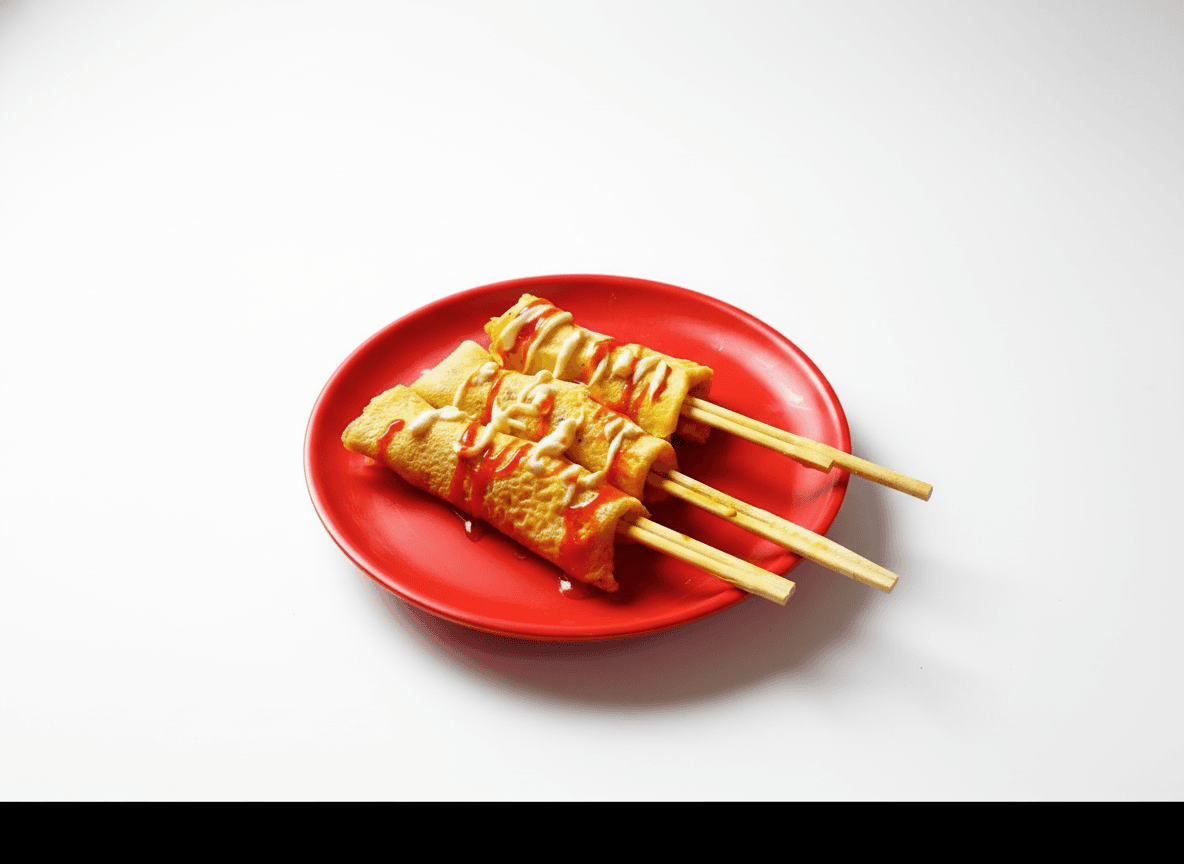
Cilung
Aci Digulung·(chee-loong)
Jajanan SD: After-School Nostalgia
The magic of the Indonesian elementary school street cart lies in the texture: a chewy, elastic tapioca crepe wrapped tightly around a bamboo skewer. Strict traditionalists use only tapioca, but street vendors know a touch of wheat flour stabilizes the roll so it behaves in a standard non-stick pan. The real secret, however, is 'abon bawang'—a highly seasoned garlic-breadcrumb dust that provides an aggressive, savory crunch against the soft dough. We recreate that street-cart alchemy effortlessly at home with toasted panko and store-bought fried shallots.
Before you start
Set up your station
Arrange 8 to 10 bamboo skewers, a small bowl of oil with a pastry brush, and your toppings right next to the stove before you begin cooking.
Ingredients
- panko breadcrumbs1/2 cup
- fried shallots2 tbsp
- garlic powder1/2 tsp
- chicken bouillon powder3/4 tsp
- sugar1/4 tsp
- tapioca starch1/2 cup
- all-purpose flour1 1/2 tbsp
- water1 cup
- salt1/4 tsp
- white pepper1/8 tsp
- eggs2 large
- water1 tbsp
- neutral oil2 tbsp
- spicy chili sprinkle1 tbsp
Method
- 01
Toast the crunch
Place a dry skillet over medium heat. Add the panko breadcrumbs and toast them, stirring constantly, until they turn light golden brown, about 3 to 4 minutes.
- 02
Mix the abon bawang
Transfer the toasted panko to a small bowl. Stir in the crushed fried shallots, garlic powder, 1/4 teaspoon of the chicken bouillon powder, and the sugar. Set this aside.
- 03
Whisk the egg layer
In a small bowl, whisk the eggs with 1 tablespoon of water and a pinch of salt and pepper until smooth and slightly frothy.
- 04
Mix the batter
In a liquid measuring cup, vigorously whisk the tapioca starch, all-purpose flour, 1 cup of water, the remaining 1/2 teaspoon of chicken bouillon powder, salt, and white pepper until all the starch is dissolved and the liquid resembles thin milk.
- 05
Heat the pan
Place an 8-inch non-stick skillet over medium-low heat. Brush the surface lightly with neutral oil so it is slick but not pooling.
- 06
Swirl the batter
Give your batter a stir, as tapioca settles rapidly. Pour 2 to 3 tablespoons into the center of the pan, immediately lifting and swirling it so the batter coats the bottom in a thin, ragged crepe.
- 07
Layer the flavor
Immediately drizzle about 1 tablespoon of the beaten egg randomly over the wet tapioca batter, then sprinkle 1 to 2 teaspoons of the toasted crunch and a dash of chili sprinkle directly onto the cooking crepe.
- 08
Roll the crepe
Watch closely. Within 1 to 2 minutes, the edges will turn translucent and begin to pull away from the pan. While the center is still slightly tacky, lay a bamboo skewer flat against one edge and roll the crepe tightly around it, pushing away from you. Press down firmly for a second at the end to seal.
- 09
Serve immediately
Remove the skewer from the pan. Repeat with the remaining batter, brushing the pan with oil each time, and eat them hot while the tapioca is deeply elastic.
Notes
Stir before you pour
Tapioca starch settles at the bottom of the liquid almost instantly. Keep a whisk or fork in the measuring cup and agitate the batter right before pouring every single batch.
Timing the roll
The batter acts as its own glue. If you wait until the crepe is entirely dry and opaque, it will not adhere to the skewer. Roll it while the top surface still looks a little sticky.
Eat it hot
This is street food meant to be devoured immediately. As tapioca cools, it undergoes rapid retrogradation, turning from wonderfully chewy to tough and rubbery within a half hour.