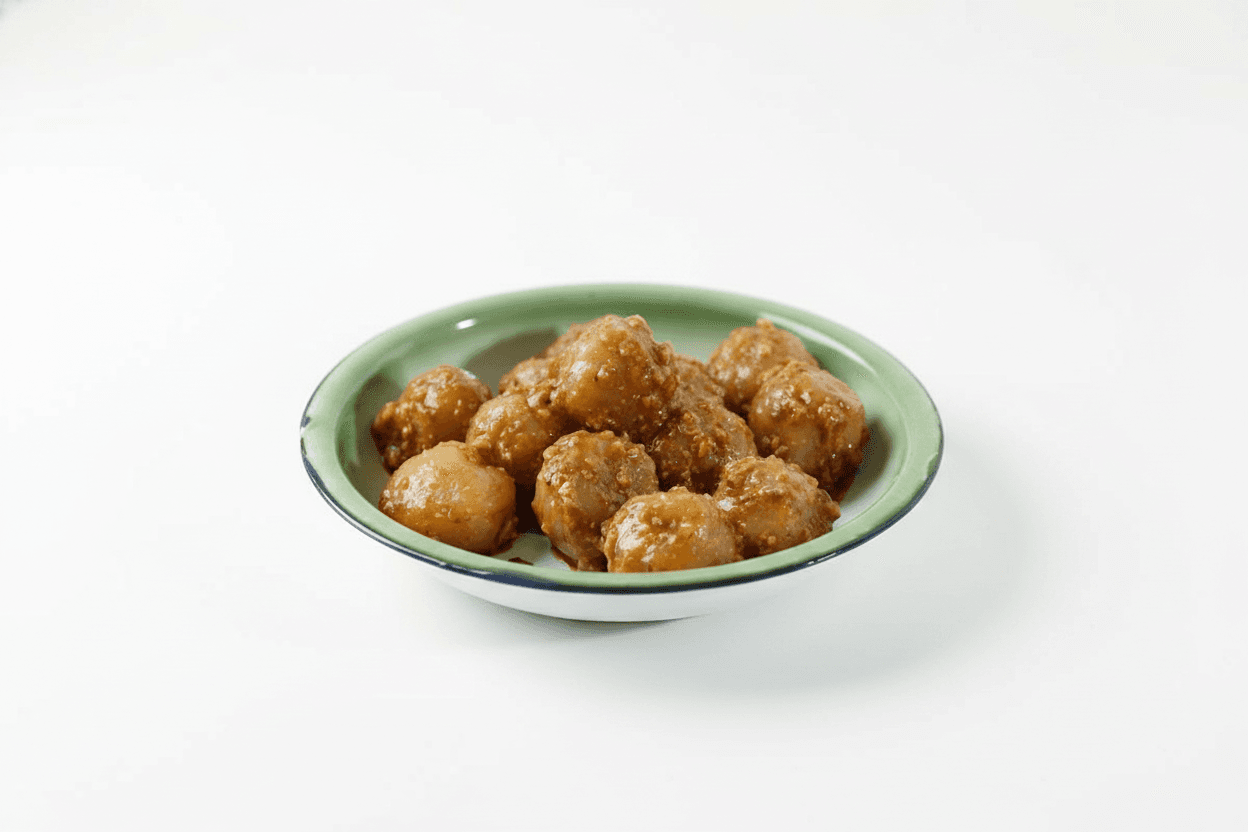
Cilok Bumbu Kacang
(chee-lohk boom-boo kah-chahng)
Jajanan SD: After-School Nostalgia
When first-generation kids talk about the smells of the homeland, they are often talking about Jajanan SD—the snacks sold from battered wooden pushcarts outside elementary schools in Indonesia. Cilok, the undisputed king of the schoolyard, is a bouncy, savory tapioca dumpling meant to be stabbed with a bamboo skewer and dragged through a wildly fragrant peanut sauce. The heartbreak of making cilok in America is that they often turn into rubber bullets once they cool. The street vendor secret is the biang method: cooking the wheat flour with boiling water first, then steaming the dumplings after boiling so they stay incredibly tender. No fake peanut butter hacks here—frying raw peanuts and simmering them with makrut lime leaves and palm sugar will make your kitchen smell exactly like a bustling street in Bandung.
Before you start
Cassava vs. Tapioca.
Ensure you buy Tapioca Starch, not Cassava Flour. Tapioca is the extracted starch and gives the bounce; cassava is the whole root and will leave you with a gritty, broken dumpling.
Ingredients
- all-purpose flour1 cup
- tapioca starch1 cup
- garlic3 med cloves
- scallions2 med
- salt1 tsp
- chicken or mushroom bouillon powder1 tsp
- ground white pepper1/2 tsp
- boiling water1 cup
- neutral cooking oil1 tbsp
- raw skinless peanuts1 cup
- garlic3 med cloves
- shallots2 med
- Fresno or red jalapeño chilies2 large
- Thai birds eye chilies2 med
- Makrut lime leaves2 med
- dark brown or palm sugar3 tbsp
- tamarind paste1 tbsp
- sweet soy sauce1 tbsp
- salt1 tsp
- water1 1/2 cup
- sweet potato1/4 cup
- neutral cooking oil3 tbsp
Method
- 01
Fry the aromatics.
In a wok or skillet, heat 3 tablespoons of neutral oil over medium heat, frying the peanuts, roughly chopped garlic, shallots, and both chilies until the peanuts are golden brown and intensely aromatic.
- 02
Blend the peanut paste.
Transfer the fried mixture and residual oil to a food processor, adding the mashed sweet potato, brown sugar, tamarind water, and salt, then blend until it forms a fine, slightly textured paste.
- 03
Simmer until the oils separate.
Return the paste to the skillet, stir in the 1 1/2 cups of water, bruised makrut lime leaves, and sweet soy sauce, simmering over medium-low heat until the sauce darkens and the peanut oils pool at the edges.
- 04
Gelatinize the flour base.
In a large heat-proof bowl, whisk the all-purpose flour, grated garlic, scallions, salt, bouillon, and white pepper, then pour in the rolling boiling water and stir vigorously until it seizes into a thick, gluey paste.
- 05
Knead in the tapioca.
Once the paste is just cool enough to handle, add the tapioca starch and 1 tablespoon of oil, kneading with your hands only until a smooth dough forms, being careful not to overwork it.
- 06
Shape and boil the dumplings.
Pinch off marble-sized pieces of dough, roll them into smooth balls, and drop them into a large pot of boiling water until they float to the surface.
- 07
Steam to lock in the texture.
Transfer the floating dumplings directly into a steamer basket set over simmering water and steam for 15 to 20 minutes to set the glossy exterior and guarantee a soft, chewy bite that survives cooling.
- 08
Serve like a street vendor.
Skewer the warm cilok on bamboo sticks, drown them generously in the warm peanut sauce, and hit them with a squeeze of fresh lime juice and an extra drizzle of sweet soy sauce.
Notes
The sweet potato hack.
Blending a little boiled sweet potato into the peanut sauce is an old vendor trick that thickens the sauce luxuriously and adds natural sweetness without needing a massive mound of expensive peanuts.
The science of soft cilok.
Pre-cooking the wheat flour with boiling water creates a water-roux that inhibits starch retrogradation, preventing the tapioca from turning into a rubber ball when it hits room temperature.