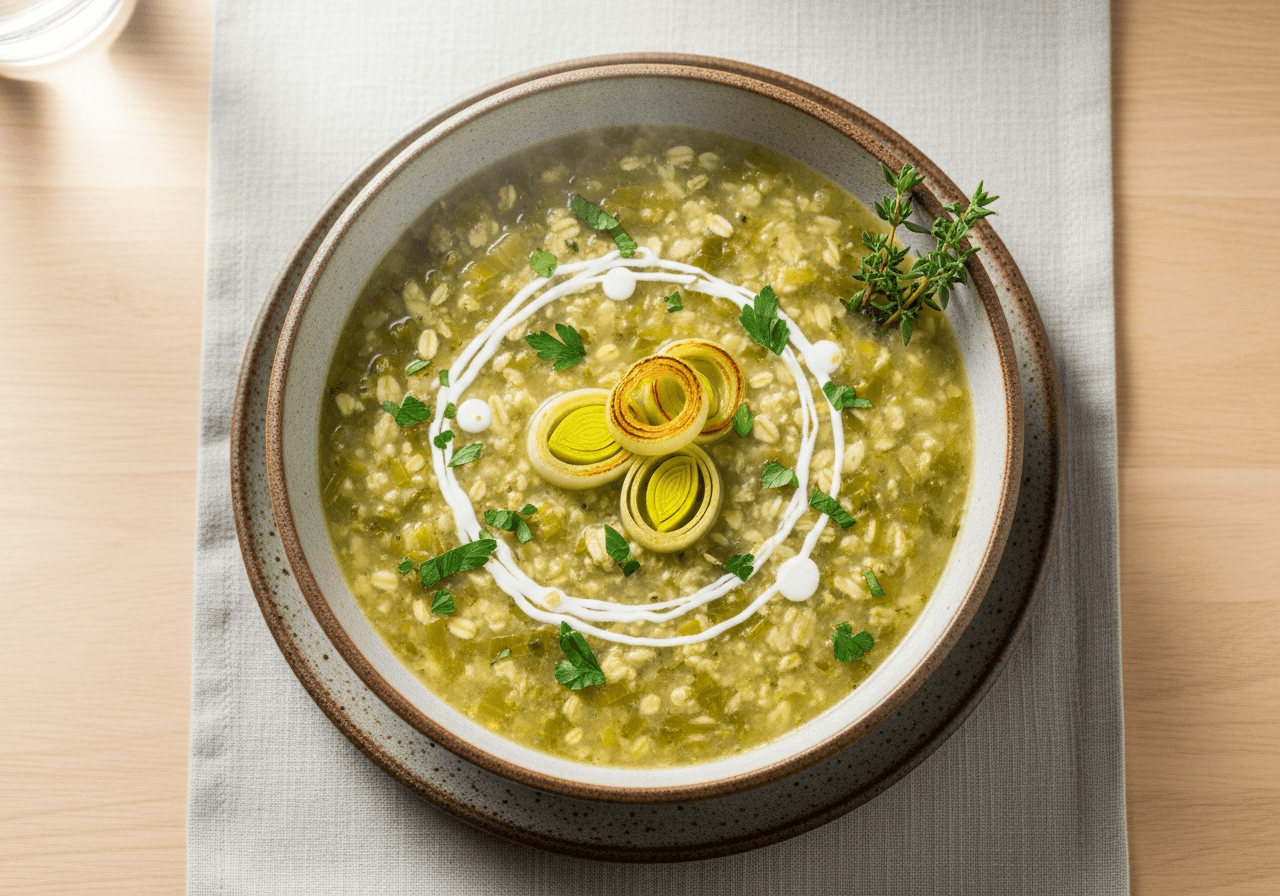
Brotchán Roy (The King's Leek and Oatmeal Broth)
Irish Gaelic·(braw-chawn roy)
Chapter 3: The Food Mom Made When I Was Sick (Invalid Cookery and Healing Bowls)
Before the potato laid claim to Irish soil, there were leeks and there were oats. Brotchán Roy, which translates to the king's broth, is the stuff of ancient monks and sensible mothers. It is a restorative pot of swelling starch, sweet allium, and rich dairy designed to coat a battered stomach and mend the soul. It isn't asking for a Michelin star; it is simply honest, unapologetically thick, and deeply comforting when the world, or a stubborn flu, has kicked the teeth out of you.
Before you start
Aggressively wash the leeks.
Leeks are grown in sandy soil and hide grit between their tightly packed layers. Slice off the dark green tops, halve the stalks lengthwise, thinly slice into half-moons, and submerge them in cold water for five minutes so the dirt falls to the bottom before gently scooping them out.
Ingredients
- Unsalted butter, preferably European-style3 tablespoons
- Large leeks, white and light green parts only3 to 4
- High-quality chicken or vegetable broth4 cups
- Steel-cut oats1/2 cup
- Whole milk2 cups
- Kosher salt1/2 teaspoon
- Ground mace or nutmeg1/4 teaspoon
- Freshly ground white or black pepper1/4 teaspoon
- Heavy cream1/4 cup
- Fresh parsley or chives, finely chopped2 tablespoons
Method
- 01
Sweat the alliums low and slow.
Melt the butter in a heavy-bottomed Dutch oven over medium-low heat, add the cleaned leeks, and sauté gently for ten to twelve minutes until meltingly tender. The goal is to soften the alliums without letting them brown, coaxing out their natural sweetness.
- 02
Hydrate the oats.
Pour in the broth, increase the heat to medium-high, and bring to a gentle boil. Slowly sprinkle in the oats while stirring vigorously, keeping them moving so they do not clump at the bottom of the pot.
- 03
Simmer the broth into a restorative porridge.
Reduce the heat to low, stir in the salt, mace, and pepper, then cover the pot. Let it simmer gently for thirty to thirty-five minutes, stirring occasionally, until the oats are fully tender and the liquid has thickened into a heavy, soothing suspension.
- 04
Fold in the dairy with caution.
Uncover the pot and stir in the whole milk, cooking on low for another ten minutes to allow the flavors to meld. Do not let the soup reach a rapid boil from here on out, or the milk will split and ruin the texture.
- 05
Finish and serve hot.
Taste for seasoning, stir in the heavy cream right at the end for an extra layer of luxury, and ladle into deep bowls garnished with the fresh herbs. If the patient requires a perfectly smooth texture, take an immersion blender to the pot before adding the cream.
Notes
Swap the oats if time is short.
If patience is lacking or the throat is particularly sore, substitute an equal amount of old-fashioned rolled oats. The texture will be softer and the simmering time drops to a mere fifteen minutes.
Respect the leftovers.
As it cools, the oat starches will absorb the remaining liquid, turning the broth into a dense porridge. Simply whisk in a splash of milk or broth when reheating on the stove to restore its silky soup texture.
Keep it plant-based if needed.
Swap the butter for olive oil and the dairy for an unsweetened oat milk, which naturally complements the flavor profile of the steel-cut oats.
Do not skip the mace.
The warm, aromatic spice provides a deeply nostalgic aroma that has stimulated the digestion of convalescents for centuries, neatly cutting through the richness of the dairy.
From The Irish American Table.