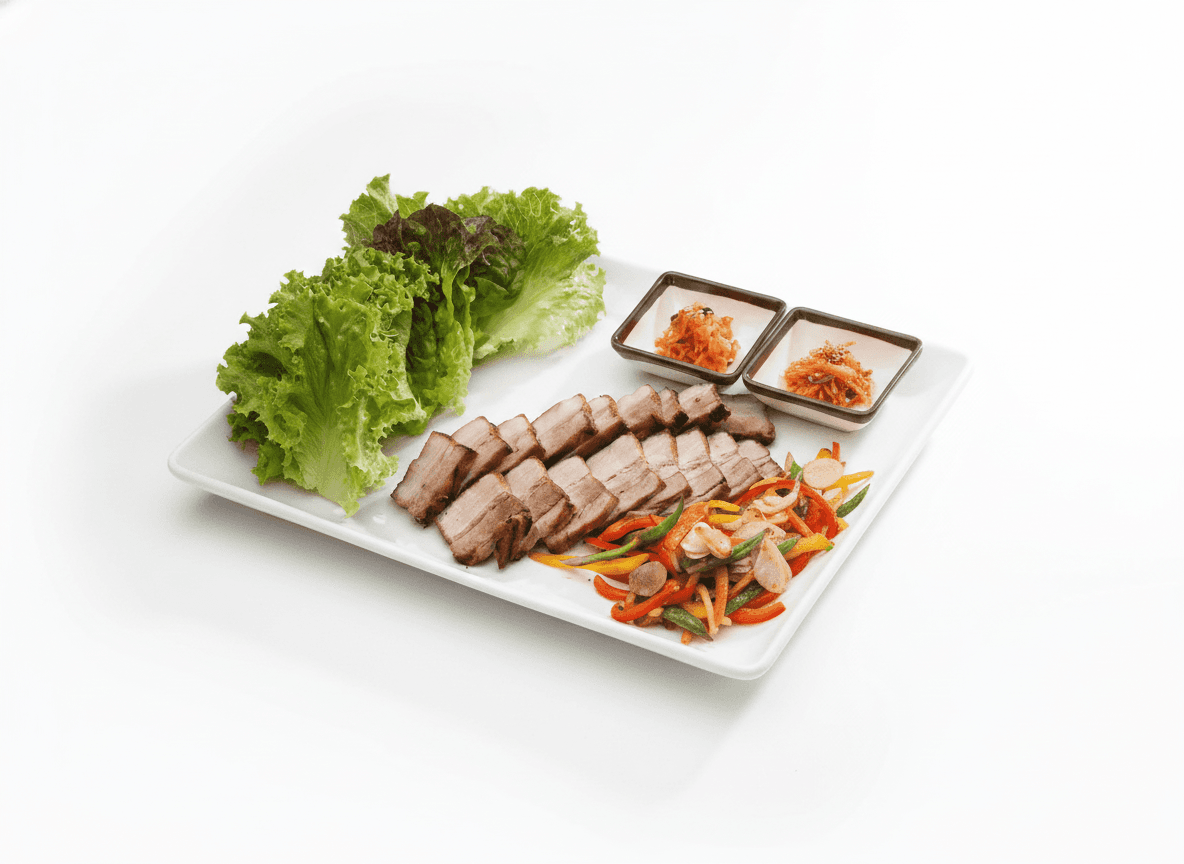
Bossam
보쌈·(bos-sam)
Halmoni's Weekend Projects
The smell of boiling pork and doenjang is the scent of communal labor and family gatherings. Born from Gimjang, the exhausting autumn kimchi-making season, bossam is the ultimate worker's reward. The stove does the heavy lifting here, turning a cheap slab of pork belly into melt-in-the-mouth perfection with two grandmotherly secrets: cheap instant coffee to strip away the gaminess, and a ruthless corn syrup dehydration trick that makes the radish salad crunch loud enough to hear across the table. Unfussy, un-Hollywood, and deeply authentic.
Before you start
Leave the onion skins on.
When prepping your aromatics for the boil, wash the yellow onion and green onions but leave the skins and roots attached. They provide essential color and deep, earthy flavors to the master stock.
Ingredients
- pork belly2 lb
- water10 cup
- yellow onion1/2 large
- green onion3 med
- garlic clove8 large
- ginger1 med
- doenjang2 tbsp
- instant coffee powder1 tbsp
- black peppercorn1 tsp
- dried bay leaf3 med
- soju1/4 cup
- Korean radish1 1/2 lb
- coarse sea salt2 tbsp
- mulyeot1/2 cup
- gochugaru1/2 cup
- fish sauce3 tbsp
- garlic2 tbsp
- ginger1 tsp
- sugar2 tbsp
- scallion3 med
- napa cabbage1 small
- coarse sea salt1/4 cup
- ssamjang1/4 cup
- saeujeot2 tbsp
- gochugaru1 tsp
- sesame oil1 tsp
- garlic1 tsp
- jalapeno1 med
Method
- 01
Salt the cabbage.
In a large basin, dissolve half of the 1/4 cup salt in warm water and dunk the cabbage quarters. Sprinkle the remaining salt between the thick white layers of the stems. Let rest for 2 hours until the stems bend without snapping, then rinse thoroughly under cold water three times and gently squeeze dry.
- 02
Dehydrate the radish.
In a bowl, toss the radish matchsticks with 2 tablespoons of coarse salt and the mulyeot. Let sit for 1 to 1.5 hours. The syrup will draw out an astonishing amount of water via osmosis.
- 03
Squeeze and season the radish.
Drain the pooled liquid, then use a cheesecloth or your bare hands to squeeze the radish as hard as you can to extract all remaining water. Toss the dry radish with the 1/2 cup gochugaru to stain it red, then massage in the fish sauce, 2 tablespoons minced garlic, 1 teaspoon minced ginger, and sugar before folding in the chopped scallions.
- 04
Boil the aromatics.
In a large Dutch oven, combine the water, yellow onion, green onions, whole garlic cloves, sliced ginger, peppercorns, and bay leaves. Whisk in the doenjang and instant coffee powder, then bring to a vigorous, rolling boil.
- 05
Sear and simmer the pork.
Only when the water is furiously boiling, gently lower the pork belly into the pot to sear the exterior and lock in the juices, followed by the soju. Leave uncovered on high heat for 10 minutes so volatile odors escape, then reduce the heat to medium-low, cover, and simmer for 45 to 50 minutes until a chopstick pierces the meat with zero resistance.
- 06
Rest the meat in the broth.
Turn off the heat but do not remove the pork. Leave the lid on and let the meat steep in the hot, aromatic liquid for 15 to 20 minutes, allowing the muscle fibers to relax and reabsorb moisture.
- 07
Prepare the seasoned shrimp.
In a small ramekin, mix the saeujeot, 1 teaspoon gochugaru, sesame oil, 1 teaspoon minced garlic, and minced jalapeño.
- 08
Slice and assemble.
Remove the pork to a cutting board and slice against the grain into 1/4-inch pieces. Serve family-style on a large platter, instructing everyone to wrap a slice of pork, a dab of salted shrimp, ssamjang, and the crunchy radish salad inside a pliable cabbage leaf.
Notes
Instant coffee is non-negotiable.
Don't balk at putting cheap instant coffee in your pork broth. It's a ubiquitous, highly authentic grandmother trick that neutralizes gaminess and gives the meat an appetizing dark exterior without making it taste like a morning roast.
The radish must be ruthlessly squeezed.
The mulyeot pulls the water out, but you must physically wring the radish dry. The drier the radish, the more aggressively it will crunch when you bite into the wrap.
Saeujeot aids digestion.
Korean matriarchs insist on eating pork with this salted fermented micro-shrimp because it contains lipase, a fat-breaking enzyme. If you're squeamish about the tiny black eyes, just mince it into a fine paste before mixing.
Pork sourcing.
Ask your butcher for a block of skinless pork belly at least 2 inches thick. If a whole slab is impossible to find, a boneless pork shoulder roast (Boston Butt) works beautifully with this exact boiling method.
From Cook Korean in America.