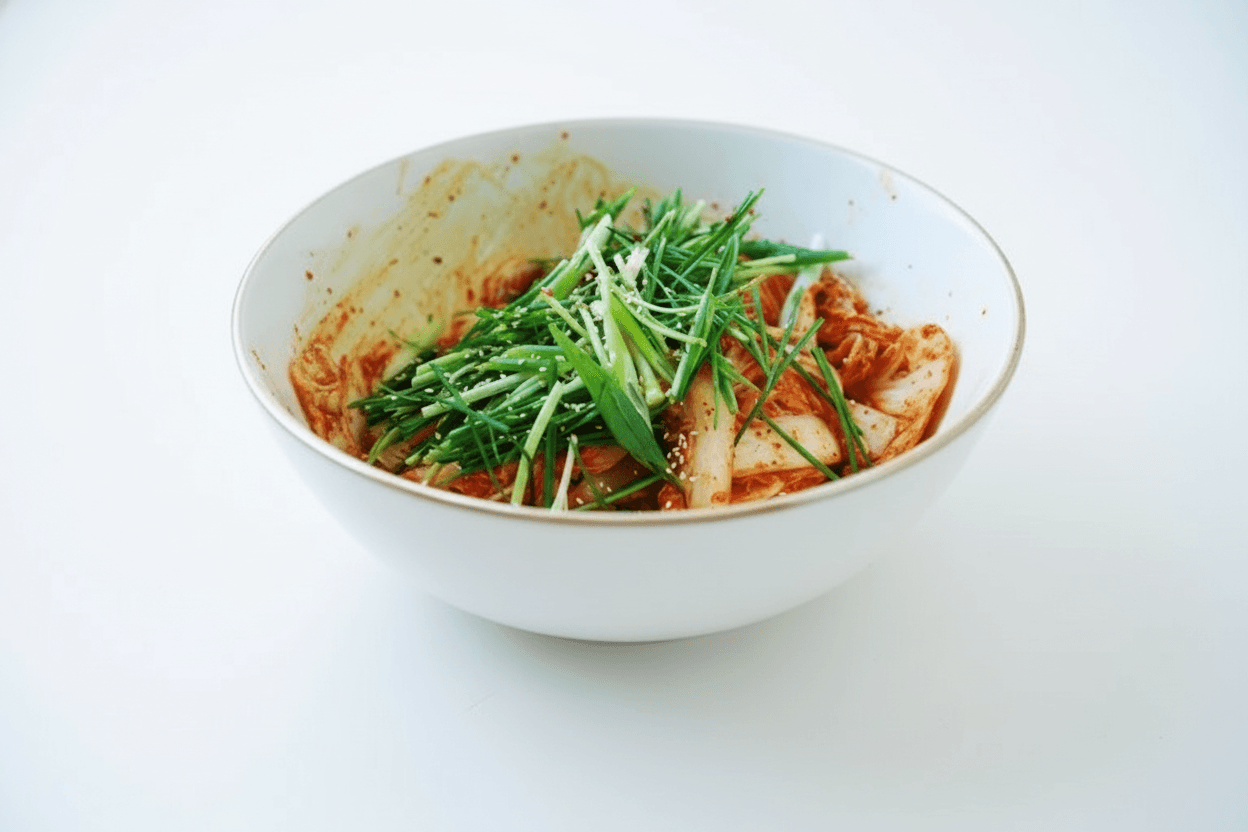
Baechu Geotjeori
배추겉절이·(bae-chu geot-jeo-ri)
The Sunday Church Potluck
If you grew up in a first-generation Korean household in the American Midwest, you know the smell of the church basement after Sunday service. The undisputed star of those folding-table feasts was always geotjeori—loud, crunchy, aggressively garlicky fresh kimchi built for immediate gratification. Because it bypasses the long fermentation of winter kimchi, it requires a different balancing act: a little more sweetness, a sharper umami, and a brilliant grandmother’s trick to make the sauce stick. Tossing a spoonful of cold, leftover rice into the blender instantly creates a luscious paste that coats every single leaf, delivering the un-Hollywood taste of home in under an hour.
Before you start
Source the correct cabbage.
Look for Albaechu, or baby Napa cabbage with a tender yellow heart. If using a large standard cabbage, peel away and discard the tough, dark green outer leaves, strictly utilizing the pale yellow core for its naturally high sugar content.
Select the right salt.
Standard iodized table salt will render the cabbage bitter and overly salty. Seek out coarse Korean sea salt (cheonilyeom) or use Diamond Crystal Kosher salt to properly extract the water.
Ingredients
- baby Napa cabbage1 med
- coarse Korean sea salt1/2 cup
- cold water1 cup
- yellow onion1/4 med
- cold cooked white rice1 tbsp
- Korean anchovy fish sauce6 tbsp
- salted shrimp1 tbsp
- apple or Asian pear1/4 small
- gochugaru6 tbsp
- garlic2 tbsp
- fresh ginger1/2 tbsp
- Korean plum extract2 tbsp
- granulated sugar1 tbsp
- scallions4 med
- toasted sesame oil1 tbsp
- toasted sesame seeds2 tbsp
Method
- 01
Slice the cabbage to maximize surface area.
Cut the separated cabbage leaves lengthwise down the middle, then on a slight diagonal into long, bite-sized pieces, leaving them slightly wet after a quick rinse.
- 02
Brine the leaves with coarse salt and water.
Scatter a handful of the wet cabbage into a large bowl, sprinkle with coarse salt, and repeat in layers before pouring over the cold water and any remaining salt.
- 03
Let the cabbage sit until it passes the bend test.
Let it rest on the counter for 45 minutes, tossing firmly from bottom to top at the 20-minute mark. You know it is ready when the thick, white fleshy part of the leaf can be bent into a 'U' shape without snapping.
- 04
Rinse the cabbage vigorously and drain it completely.
Dump the cabbage into a colander in the sink and rinse it under cold running water two to three times to wash away the excess surface salt. Let it drain for at least 20 minutes so residual water doesn't dilute your seasoning.
- 05
Blend the wet aromatics with the cold rice.
While the cabbage drains, combine the chopped onion, leftover cold rice, fish sauce, salted shrimp, and apple in a blender. Run it on high until it forms a perfectly smooth, silky paste.
- 06
Bloom the chili flakes to create the seasoning paste.
Pour the blended mixture into a large bowl and stir in the gochugaru, minced garlic, ginger, plum extract, and sugar. Let it sit for 5 to 10 minutes so the chili flakes hydrate into a thick, vibrant red mud.
- 07
Massage the seasoning into the cabbage by hand.
Put on a disposable kitchen glove, add the drained cabbage and chopped scallions to the red seasoning, and firmly massage the sauce into the leaves until every single piece is painted red.
- 08
Finish with sesame oil and serve immediately.
Drizzle the toasted sesame oil over the top, shower it with sesame seeds, and toss one last time before serving piled high alongside steamed rice and pork.
Notes
Embrace the cold rice shortcut.
Traditional pogi kimchi relies on a stovetop sweet rice flour porridge to bind the chili flakes. Blending a spoonful of leftover cold rice instantly gelatinizes the sauce, saving time without sacrificing an ounce of authenticity.
Do not skip the salted shrimp.
Saeujeot provides a clean, sharp marine salinity that anchors the dish to tradition. If absolutely unavailable, you can substitute an extra tablespoon of fish sauce, though the distinctive homeland flavor will be slightly diminished.
Plum extract fakes fermentation.
Because this kimchi is eaten fresh, it lacks the complex tart-sweetness of long-fermented lactic acid. Maesil cheong (plum extract) artificially constructs that balance. If you don't have it, a tablespoon of corn syrup works in a pinch.
From Cook Korean in America.