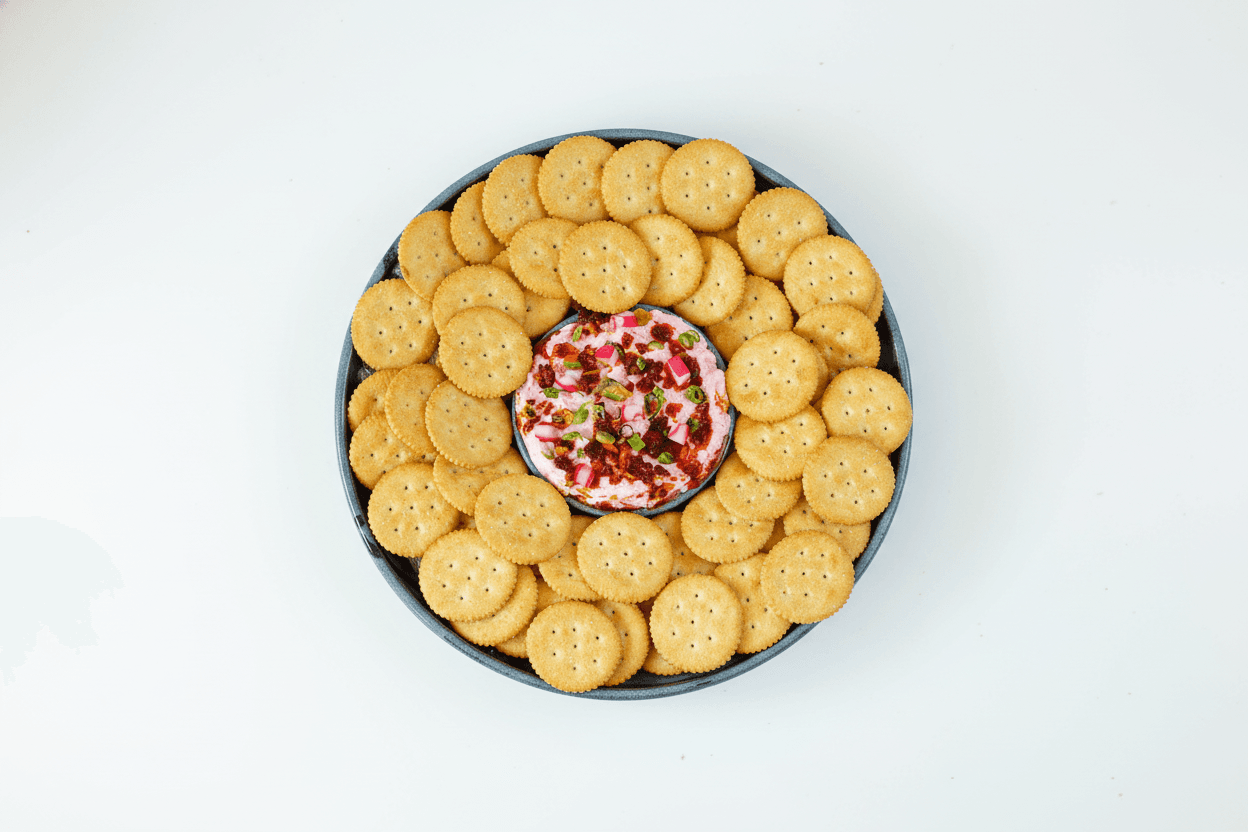
Auntie's Kamaboko Dip with Ritz Crackers
かまぼこディップ·(kamaboko dippu)
The Nikkei Heritage Table: Potlucks & Holidays
You won't find this on a menu in Tokyo. Born in the kitchens of Japanese immigrants and their descendants in Hawaii and the West Coast, this dip is the ultimate testament to diaspora ingenuity. It is a brilliant, unpretentious marriage of traditional steamed fish cake and mid-century American supermarket staples. Served at every potluck alongside a sleeve of buttery Ritz Crackers, it requires zero cooking, comes together in ten minutes, and tastes exactly like home.
Before you start
Firm up the kamaboko in the freezer.
If the fish cake is too soft to grate cleanly, place it in the freezer for 15 minutes before starting.
Ingredients
- kamaboko (pink and white Japanese steamed fish cake)6 oz
- full-fat cream cheese1/2 cup
- Best Foods or Hellmann's mayonnaise1/3 cup
- green onions1/4 cup
- canned water chestnuts1/4 cup
- hondashi (Japanese dashi powder)1/4 tsp
- kosher salt1/4 tsp
- Ritz Crackers1 box
Method
- 01
Grate the fish cake using the large holes of a box grater.
Resist the urge to use a food processor, as manual grating yields the feathery shreds essential to the traditional texture.
- 02
Vigorously mix the softened cream cheese and mayonnaise in a medium bowl until completely smooth.
Make sure the cream cheese is truly at room temperature to avoid a lumpy dip.
- 03
Gently fold the kamaboko, water chestnuts, green onions, hondashi, and salt into the dairy mixture.
Mix just until the ingredients are evenly distributed.
- 04
Cover and chill in the refrigerator for at least 30 minutes.
Patience pays off, as resting allows the sharp alliums and deep umami of the hondashi to permeate the cream cheese.
- 05
Serve chilled surrounded by a generous stack of Ritz Crackers.
Garnish with a pinch of leftover green onions. The buttery crunch of the Ritz is canonical, so accept no substitutes.
Notes
Do not use Japanese mayonnaise.
Kewpie is fantastic, but it's too sweet and rich here. Standard American mayonnaise is the undisputed secret to achieving that authentic diaspora flavor.
Imitation crab makes a flawless substitute.
If you can't find kamaboko at your local Asian market, finely shredded surimi maintains the necessary umami and texture.
The dashi is negotiable.
Hondashi adds a deep savory backbone, but if you don't have it, a tiny splash of soy sauce or a pinch of garlic salt works just fine.
From Cook Japanese in America.