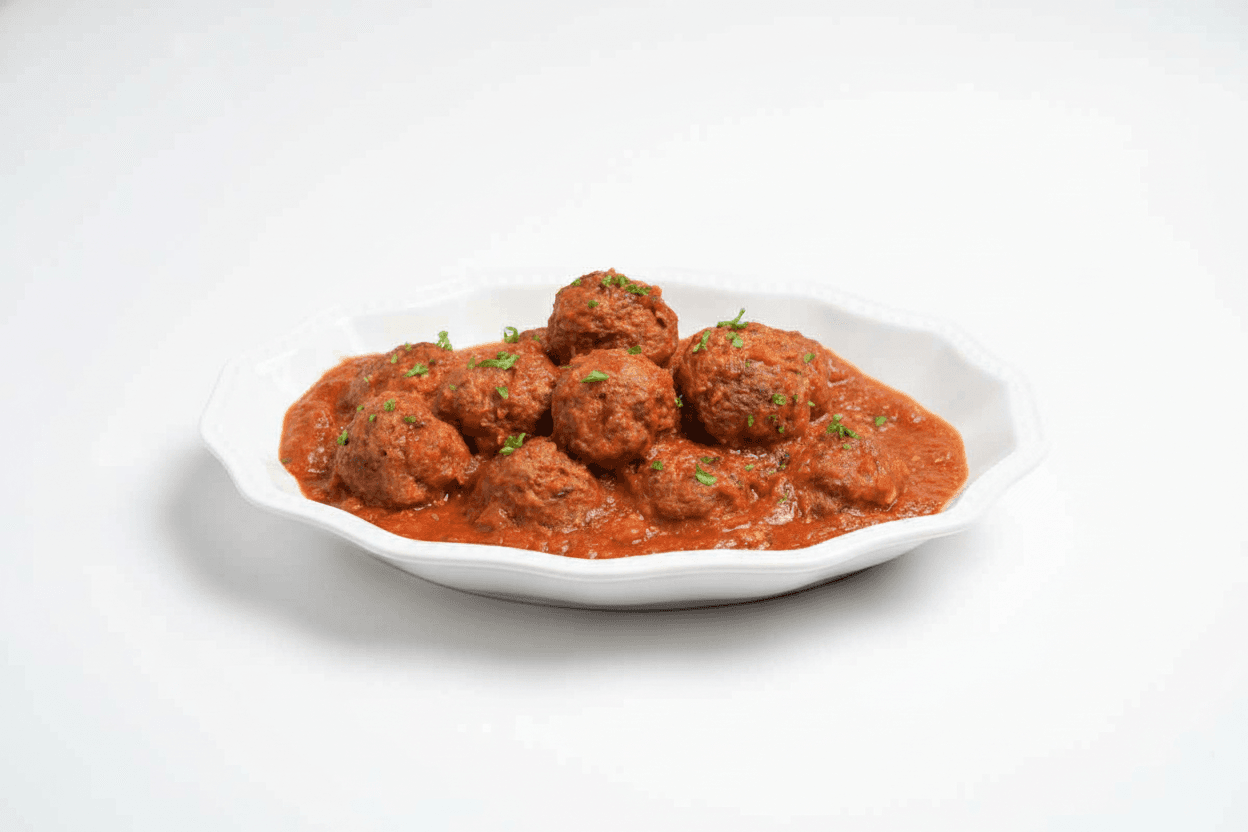
Albóndigas a la Cubana
(ahl-BOHN-dee-gahs ah lah koo-BAH-nah)
La Despensa y El Sofrito (The Foundation)
In the diaspora kitchen, the smell of onion, garlic, and bell pepper hitting hot oil isn't just cooking; it is the smell of home. These are not Italian meatballs meant to simmer all Sunday, nor are they the rice-bound Mexican albóndigas floating in broth. These are unapologetically Cuban—massive, tender, and braised in a rich sofrito sauce. The secret to that melt-in-the-mouth texture is skipping breadcrumbs entirely in favor of milk-soaked saltines, a trick lifted straight from the 1950s Havana pantry. A light dusting of flour gives them a protective crust and naturally thickens the sauce as they simmer. Serve them over a mountain of white rice, let the dry cooking wine do the heavy lifting, and taste exactly what a Tuesday night at grandmother's house was supposed to be.
Before you start
Bring the ground beef to room temperature.
Pull the beef from the refrigerator twenty minutes before mixing so it incorporates evenly with the aromatics without overworking the proteins.
Grate the aromatics for the meatballs.
Take the time to grate the onion and bell pepper into a fine paste rather than dicing them; this ensures they melt seamlessly into the beef without creating chunky textural interruptions.
Ingredients
- ground beef1 1/2 lb
- saltine crackers1 cup
- whole milk1/4 cup
- eggs2 large
- yellow onion1/4 cup
- green bell pepper1/4 cup
- garlic cloves2 med
- ground cumin1 tsp
- dried oregano1 tsp
- yellow mustard1 tsp
- kosher salt1 1/2 tsp
- black pepper1/2 tsp
- all-purpose flour1/2 cup
- olive oil3 tbsp
- yellow onion1 med
- green bell pepper1/2 med
- garlic cloves4 med
- vino seco1/2 cup
- Spanish-style tomato sauce15 oz
- water1 cup
- ketchup2 tbsp
- sugar1 tsp
- bay leaf1 med
- sweet peas1/2 cup
Method
- 01
Hydrate the cracker meal to form the binder.
In a large bowl, toss the crushed saltines with the milk and let it sit for two minutes until it forms a soft paste, ensuring a delicately tender meatball.
- 02
Mix the meat and aromatics with a light hand.
Add the ground beef, beaten eggs, grated onion, grated bell pepper, minced garlic, cumin, oregano, mustard, salt, and pepper to the cracker paste, folding gently just until combined so the proteins stay tender.
- 03
Shape the meatballs and dust them in flour.
Roll the mixture into golf ball-sized rounds, then toss them lightly in a shallow dish of all-purpose flour, tapping off the excess to create a barrier that protects them in the pan and thickens the sauce later.
- 04
Sear the meatballs to build a golden crust.
Heat the olive oil in a wide Dutch oven over medium-high heat and brown the meatballs in batches for two to three minutes per side, then transfer them to a plate while leaving the flavorful fat in the pot.
- 05
Build the sofrito base in the same pot.
Lower the heat to medium, add the diced onion and bell pepper, and sauté for five minutes until softened, scraping up the browned beef bits from the bottom before stirring in the garlic for one minute.
- 06
Deglaze the pan with vino seco and build the sauce.
Pour in the dry cooking wine and let it bubble rapidly for one minute to cook off the alcohol, then stir in the tomato sauce, water, ketchup, sugar, and bay leaf, bringing the liquid to a gentle boil.
- 07
Braise the meatballs slowly in the tomato sauce.
Nestle the seared meatballs back into the bubbling sauce, cover with a tight-fitting lid, and reduce the heat to low, simmering for 25 to 30 minutes until they are cooked through and remarkably tender.
- 08
Stir in the sweet peas to finish the dish.
Remove the lid, discard the bay leaf, and gently fold in the sweet peas, letting them warm through for two minutes before serving immediately over long-grain white rice.
Notes
The secret to the texture is cracker meal.
Avoid Italian breadcrumbs or panko; traditional galleta molida or crushed saltines yield a starchier matrix that dissolves into the meat, retaining moisture without creating dense air pockets.
Do not fear the ketchup and mustard.
While they might sound like Americanized shortcuts, yellow mustard in the meat and ketchup in the sauce were canonical pantry staples in pre-revolution Havana, providing crucial emulsification and balanced acidity.
Sourcing vino seco.
Vino seco is a salted, sherry-like Cuban cooking wine available at most Latin grocers, but if you cannot find it, substituting a standard dry white wine like Pinot Grigio with a pinch of salt works perfectly.
From Cook Cuban in America.