That Actually Happened
Copyright © 2026 Edward Benson
All rights reserved.
Cartoons are original illustrations created for this book. Every event described really happened and is documented in the historical record.
Published by The Robot Book Club
To every kid who ever said 'no way, that can't be true'—yes way, we checked.
How We Know This Really Happened
Paper Trails and Official Receipts
The ultimate way to prove something weird happened is to follow the paper trail. We're talking about clues left behind in real-time by the people who were actually there. When 323,000 gallons of hot, fermenting beer exploded out of the Horse Shoe Brewery in London in 1814, historians didn't just guess it happened. Today, you can still read the original 1814 Morning Post articles that called it an "immense mass of ruins." We even have the official court ledger from the coroner's inquest where a clerk named George Crick testified about seeing a 700-pound iron hoop snap off the giant vat.
The same goes for the Great Emu War of 1932. We don't have to rely on campfire stories to prove the Australian military tried to fight off a massive migration of crop-destroying emus. We can just read Hansard, the official printed transcripts of the Australian government. Those perfectly preserved records capture senators mocking the Minister of Defence and telling him to "get back to his emus!" When governments and courts write it down, we have proof.
Photos, Film, and Giant Wooden Ships
Paper is great, but seeing is believing. In 1970, the Oregon Highway Division tried to blow up a rotting, 8-ton dead whale with a half-ton of dynamite. Sounds totally fake, right? Nope! A TV reporter named Paul Linnman kept the film rolling as massive, rancid chunks of blubber rained from the sky and flattened a local businessman's brand-new Oldsmobile. That 16mm footage is now safely preserved in 4K resolution by the Oregon Historical Society. Or take Balloonfest '86, where 1.5 million helium balloons swallowed the skyline of Cleveland. We know exactly how bad the chaos was because photographer Thom Sheridan captured the crazy, mushroom-cloud dome of balloons on camera.
Evidence can also be a massive physical object. In 1628, a top-heavy Swedish warship called the Vasa sank just minutes into its very first voyage. For centuries, it sat at the bottom of the Baltic Sea. But in 1961, historians literally pulled the 69-meter-long ship out of the water. Today, it sits in a museum in Stockholm, 98% intact. You can walk right up and look at a 17th-century epic fail!
The Art of Cross-Checking
Just because someone wrote a story down doesn't make it true. Historians are like detectives; they never trust just one witness. They use a trick called "cross-checking," which means finding two or more independent sources to see if a story holds up. If the facts don't match, the story collapses.
For example, for decades, everyone believed an American Civil War general named Abner Doubleday invented baseball in a New York cow pasture in 1839. It was such a famous "fact" that the Baseball Hall of Fame was built there! But the whole story was based on a single letter written by a 71-year-old man named Abner Graves, who claimed he was Doubleday's childhood playmate. When modern historians cross-checked military records, they found Doubleday wasn't even in that town in 1839—he was away at the U.S. Military Academy at West Point. Plus, Graves was only five years old at the time! By checking multiple records, historians busted the myth wide open.
Building Your Legend Detector
As a reader of history, you need to learn how to spot a tall tale. Urban legends are wild stories that spread like wildfire because they are funny or scary, but they usually come with major red flags. The biggest one? The "FOAF"—which stands for "Friend Of A Friend." If a wild story has no exact dates, no specific names, and supposedly happened to your cousin's neighbor's dogwalker, your legend detector should be going off.
Sometimes, entire cities fall for a legend. For over a century, people believed the Great Chicago Fire of 1871 was started when Mrs. O'Leary's cow kicked over a lantern in a barn. There was even a catchy kids' camp song about it! But the O'Leary family testified they were fast asleep when the fire started. The real clue? In 1893, a reporter named Michael Ahern confessed that he and other journalists had completely made up the cow story just to sell newspapers. It took until 1997 for the city to officially clear Mrs. O'Leary's name. So put on your detective hat—because in this book, we're only looking at the wild things that actually happened.
Animal Mayhem
Sometimes the animals win. An army surrenders to giant flightless birds, a dead whale out-plots a highway department, and a bear gets an official military rank. Nature keeps the receipts.
Animal Mayhem · Western Australia, 1932
The Great Emu War
The Australian military deployed soldiers with machine guns to stop a flock of crop-eating birds, only to suffer a humiliating defeat.
In 1932, struggling farmers in Western Australia faced a massive problem: an estimated 20,000 migrating emus had descended on their land and were gobbling up all the wheat. Desperate to save the harvest, the government agreed to send in the military to wipe out the giant birds.
Commanded by Major G.P.W. Meredith, the Royal Australian Artillery rolled in with Lewis machine guns and 10,000 rounds of ammunition. They expected a quick victory. Instead, the emus proved incredibly fast and erratic. When the shooting started, the birds scattered into small, elusive groups.
The soldiers even tried chasing the frantic flocks in military vehicles, but the bumpy terrain made it impossible to aim. Humiliated, mocked by the public, and completely outmaneuvered, the military eventually gave up and officially withdrew. The emus had won.
How It Went Down
No, really: After firing thousands of rounds, the soldiers only managed to hit about 986 out of 20,000 birds. The defeated commander was so stunned that he publicly claimed the emus could face machine guns with the invulnerability of tanks.
Crazy-o-Meter: 4 out of 5

Animal Mayhem · Florence, Oregon, 1970
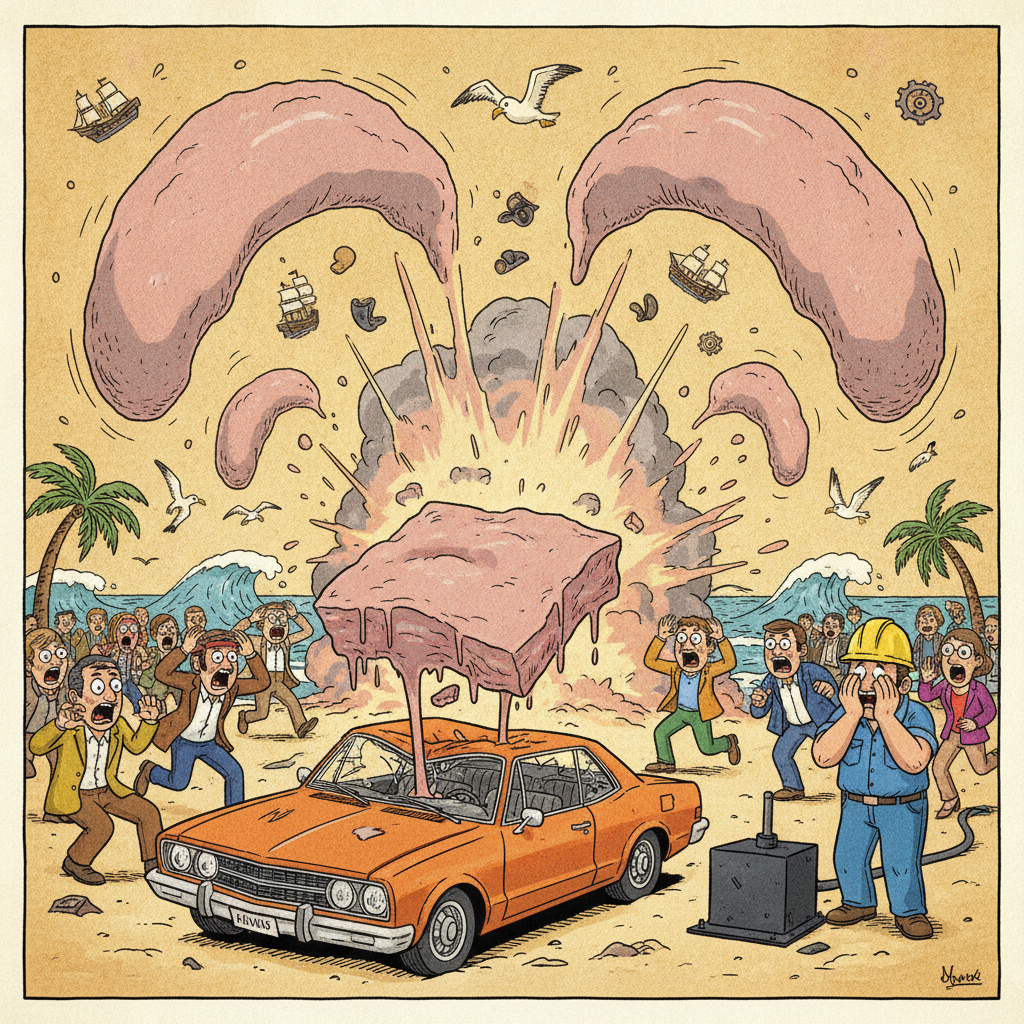
The Exploding Whale
To get rid of a massive beached whale, highway engineers decided to blow it to pieces with a half-ton of dynamite.
In November 1970, a 45-foot, 8-ton sperm whale washed ashore on an Oregon beach. As it sat in the sun, the massive carcass created an unbearable, rotting stench. The Oregon State Highway Division was put in charge of the cleanup, and engineer George Thornton hatched a highly unusual plan.
Thornton decided to pack a half-ton of dynamite under the whale. The theory was that a massive blast would vaporize the beast into tiny, bite-sized snacks for local seagulls. Despite a military veteran warning them that they were using way too much explosive, the highway workers cleared the beach and pushed the plunger.
The explosion did not vaporize the whale. Instead, it launched colossal chunks of rotting blubber hundreds of feet into the air. Screaming spectators had to sprint for their lives as a disgusting rain of heavy, foul-smelling whale meat battered the town.
How It Went Down
No, really: The blast launched blubber with such extreme force that a massive chunk flew a quarter-mile away and completely crushed the passenger compartment of a parked car.
Crazy-o-Meter: 5 out of 5
Animal Mayhem · Uitenhage, South Africa, 1881–1890
Jack the Signalman
When a double-amputee railway guard needed help, he trained a pet baboon to perfectly operate the heavy track switches.
James "Jumper" Wide was a South African railway guard who lost both of his legs in a terrible train accident. Desperate for assistance, he went to a local marketplace and bought a clever Chacma baboon named Jack to help push his wooden wheelchair.
Jack proved incredibly smart. Soon, Wide taught the baboon to operate the station's heavy track-switching levers. Listening to specific train whistle codes while under Wide's direct visual supervision, Jack always pulled the correct levers to guide massive locomotives safely to their platforms.
When a passenger looked out her window and saw a baboon running the railway, she panicked. Government inspectors rushed to the station, fully expecting a disaster. Instead, they watched Jack perform his duties with absolute perfection.
Astounded by the baboon's flawless track record, the railway authorities decided not to fire Wide. Instead, they did something completely unprecedented: they put the animal on the payroll. Jack worked at the station for nine years, never making a single recorded mistake.
How It Went Down
No, really: The Cape Government Railways officially hired the baboon, assigning Jack an employment number and a formal salary of 20 cents a day, plus half a bottle of beer each week.
Crazy-o-Meter: 4 out of 5

Animal Mayhem · Iran and Italy, 1942–1944
Wojtek the Soldier Bear
When the Polish Army adopted a massive brown bear, they had to find a creative way to bring him to war.
In the spring of 1942, Polish soldiers traveling through Iran bought an orphaned Syrian brown bear cub at a train station. They named him Wojtek. The troops nursed the tiny bear with condensed milk from an old vodka bottle, and he quickly became part of the 22nd Artillery Supply Company.
Wojtek didn't stay small for long. He grew into a towering 500-pound bear who mimicked his human friends. He playfully wrestled with the soldiers, learned to march alongside them, and even developed a taste for drinking beer in camp.
When it was time to sail to Europe to fight, British transport ships strictly banned all pets. To bypass the rules, the Polish Army refused to leave Wojtek behind. They simply made him a soldier.
Wojtek sailed to Italy as an official member of the military. He survived the war and eventually enjoyed a long, peaceful retirement as a major celebrity at the Edinburgh Zoo in Scotland.
How It Went Down
No, really: To get him onto the ship, the army officially enlisted the 500-pound bear as a Private, complete with a government paybook and an official daily ration allowance for cigarettes.
Crazy-o-Meter: 4 out of 5

Animal Mayhem · San Juan Island, 1859
The Pig War
A hungry farm animal rooting for potatoes accidentally triggered a massive, weeks-long military standoff between two world superpowers.
In 1859, the United States and Great Britain both claimed ownership of San Juan Island. Tensions between American settlers and British residents were already boiling when an American named Lyman Cutlar spotted a British-owned pig rooting through his potato garden. Cutlar shot the pig.
When British authorities threatened to arrest Cutlar, the U.S. military dispatched Captain George Pickett and a group of soldiers to protect the Americans. Refusing to back down, the British military immediately retaliated by sending heavily armed warships to the island's coast.
The situation rapidly escalated into a massive standoff. Fortunately, commanders on both sides eventually decided that starting an international war over a dead farm animal was a terrible idea. They refused to open fire, and diplomats peacefully settled the dispute. The pig was the only casualty.
How It Went Down
No, really: A dispute over a single dead pig escalated until 461 American soldiers with 14 field cannons were locked in a direct standoff against three British warships carrying 52 heavy naval guns.
Crazy-o-Meter: 4 out of 5

Animal Mayhem · Sulawesi, Indonesia, 2011
The Monkey Selfie
When a curious macaque snapped a perfectly framed picture of himself, he accidentally sparked a bizarre federal lawsuit.
In 2011, British nature photographer David Slater was tracking a troop of crested macaque monkeys in an Indonesian nature reserve. Hoping for some close-up shots, Slater set up his camera on a tripod, adjusted the lighting, and briefly stepped away.
A curious six-year-old macaque named Naruto soon wandered over to investigate the strange equipment. Fascinated by the lens, Naruto reached out and pressed the shutter button repeatedly. Among the blurry outtakes was a perfectly framed, wildly grinning selfie of the monkey.
The hilarious picture quickly went viral across the internet. But the fun stopped when an animal rights group sued the photographer. They argued that because Naruto the monkey had physically pressed the button, he—not the human—legally owned the copyright to the famous photo.
How It Went Down
No, really: The incident resulted in a genuine U.S. federal court ruling explicitly stating that animals cannot hold copyrights, officially denying the monkey the intellectual property rights to his own selfie.
Crazy-o-Meter: 4 out of 5

Weird Weather and Strange Skies
The sky has moods. Some years it snows in June, some nights the whole world glows pink, and some afternoons it genuinely rains fish. Meteorologists wrote it all down.
Weird Weather and Strange Skies · New England, 1780
New England's Dark Day
A massive, impenetrable darkness swallowed the Northeastern United States, tricking confused farm animals into thinking it was midnight at noon.
In the days leading up to May 19, 1780, the New England sky turned a sickly yellow. An angry, blood-red sun beat down, accompanied by the heavy stench of soot. But the real panic started when the sun completely vanished.
By 10:30 a.m., a solid black wall of darkness swallowed the region. At high noon, people couldn't see a person standing across the room. Confused chickens went to roost, roosters crowed, and frogs began peeping in the middle of the afternoon.
The blackout lasted for hours. When the moon finally rose, it was glowing red. People panicked, but tree rings now prove it wasn't the apocalypse: massive Canadian wildfires had pumped columns of smoke into the sky, mixing with thick fog to entirely blot out the sun.
How It Went Down
No, really: When the Connecticut legislature panicked and tried to adjourn for Judgment Day, Councilman Abraham Davenport refused. He stated he wished to be found doing his duty when the world ended, and simply ordered candles brought in.
Crazy-o-Meter: 4 out of 5

Weird Weather and Strange Skies · Global, 1815–1816
The Year Without a Summer
A colossal volcanic eruption plunged the Earth into a freezing gloom, turning summer into a snow-filled nightmare.
On April 5, 1815, Mount Tambora in Indonesia blew its top in the largest volcanic explosion in recorded history. It blasted an immense amount of ash and microscopic sulfate aerosols high into the sky, which the jet stream dragged entirely around the globe.
This massive dust cloud acted like a cosmic umbrella, heavily dimming the Sun's radiation. By May 1816, the Northern Hemisphere was plunged into a persistent gloom. Because solar activity was already hitting a record low, the world got exceptionally cold.
Summer never arrived. Gloomy, freezing rains pelted Europe, and widespread crop failures sparked severe food shortages. The price of oats skyrocketed, which disrupted horse-based travel! Faced with freezing fields and starvation, droves of farming families packed up and migrated out of New England.
How It Went Down
No, really: Earth's average global temperature dropped by up to three degrees Celsius, resulting in documented, heavy snowfall across New England during the middle of June.
Crazy-o-Meter: 4 out of 5

Weird Weather and Strange Skies · Global, September 1859
The Carrington Event
A massive burst of solar energy slammed into Earth, setting the skies on fire and turning night into day.
On September 1, 1859, British astronomer Richard Carrington was sketching sunspots when a blinding white flash erupted on the Sun's surface. He had just witnessed the first recorded solar flare. Seventeen hours later, a massive wave of charged particles slammed into Earth's magnetic field.
The impact triggered spectacular, pulsing auroras across the globe, reaching as far south as Hawaii and the Caribbean. The midnight sky glowed so intensely that confused birds began to sing, and city dwellers woke up and read the newspaper outdoors, convinced the sun was rising.
The intense magnetic storm also wreaked havoc on the world's newest technology: the telegraph. The fluctuating magnetic fields pumped massive electrical currents directly into global telegraph wires. Operators received severe electric shocks, and their machine paper literally burst into flames.
How It Went Down
No, really: Telegraph operators completely unplugged their machines from all power sources and were still able to send messages from Boston to Portland, powered entirely by the ambient electrical current generated by the solar storm.
Crazy-o-Meter: 4 out of 5

Weird Weather and Strange Skies · Central Siberia, 1908
The Tunguska Event
A blinding fireball streaked across the Siberian sky and unleashed a massive explosion that instantly flattened 80 million trees.
Early on June 30, 1908, witnesses in remote Siberia saw a blinding white-blue fireball streak across the cloudless morning sky. Seconds later, it detonated five to ten kilometers above the earth with a thunderous roar.
The mid-air explosion was catastrophically huge. A massive shockwave slammed into the ground, instantly flattening roughly 80 million trees in a giant outward butterfly pattern. The blast knocked people off their feet forty miles away and sent pressure waves around the entire globe.
For days afterward, folks across Eurasia experienced bizarre "bright nights" because high-altitude ice clouds reflected the sun. Decades of wild rumors blamed crashing alien spaceships, but modern science confirms it was a massive, stony meteor blowing up from extreme atmospheric friction.
How It Went Down
No, really: The explosion unleashed the energy of up to 15 megatons of TNT—hundreds of times more powerful than an atomic bomb—yet left absolutely no crater. The massive rock completely vaporized in mid-air before hitting the ground.
Crazy-o-Meter: 5 out of 5

Weird Weather and Strange Skies · Marksville, Louisiana, 1947
The 1947 Marksville Fish Fall
On a calm, foggy morning, hundreds of live fish suddenly rained down from the sky onto businessmen and cars.
On the morning of October 23, 1947, the weather in Marksville, Louisiana, was foggy and totally calm. But out of nowhere, hundreds of live, flapping fish began plummeting from the sky. They smacked into businessmen walking to work and bounced off the roofs of houses and cars.
Lucky for science, a professional biologist named A.D. Bajkov happened to be eating breakfast in a local restaurant. When a waitress alerted him to the bizarre downpour, he rushed outside with formaldehyde jars to investigate the scene.
Bajkov proved the two-to-nine-inch largemouth bass, sunfish, and hickory shad were all local freshwater species. The day before, small tornadoes called "devil dusters" had vacuumed the fish out of nearby waters. Updrafts held them inside the clouds overnight until the storm finally ran out of energy and dropped them.
How It Went Down
No, really: Because a professional biologist was eating breakfast right in the middle of the drop zone, he was able to scientifically calculate that exactly one fish fell per square yard.
Crazy-o-Meter: 4 out of 5

Weird Weather and Strange Skies · Kerala, India, 2001
The Kerala Red Rain
When blood-red rain began falling over southern India, panicked residents feared the end of the world was at hand.
On July 25, 2001, a loud thunderclap cracked the sky over the Indian state of Kerala. Then, the rain started falling. But this wasn't normal summer weather—the water pouring from the clouds was the color of dark, terrifying blood.
The gruesome downpours hit in localized bursts, often lasting less than twenty minutes. The strange storms continued sporadically for two months, sparking widespread panic as the heavily pigmented rain permanently stained the town's drying laundry a vibrant pink.
The Indian government launched an official investigation. Scientists initially suspected dust from an exploding meteor, while a few wild rumors blamed alien lifeforms. But when botanists looked through their microscopes, they didn't find space dust—they found living cells.
The terrifying blood rain was actually Trentepohlia annulata, a species of earthly green algae packed with bright red pigments. Millions of microscopic spores had been swept high into the storm clouds by the wind before raining back down.
How It Went Down
No, really: Biologists calculated that every single milliliter of the rainwater contained about nine million algae spores. In total, an astonishing 110,000 pounds of red algae rained down on the state of Kerala over the course of two months.
Crazy-o-Meter: 4 out of 5

Great Blunders
Everyone makes mistakes — but not everyone sinks a warship on day one or loses a spacecraft over a math mix-up. These are history's most spectacular oopsies, all fully documented.
Great Blunders · Stockholm Harbor, Sweden, 1628
The Sinking of the Vasa
A Swedish king demanded the ultimate warship, but his mid-construction design changes made the magnificent vessel too top-heavy to float.
In the 1620s, King Gustav II Adolf of Sweden ordered the ultimate warship. Mid-construction, he demanded a major upgrade: an unprecedented second enclosed gun deck. When the original Dutch shipwright died, his assistants were left to cram 64 heavy bronze cannons and massive wooden sculptures onto a 111-foot keel meant for a smaller ship.
The result was a magnificent but terrifyingly top-heavy vessel. On August 10, 1628, the grand warship set out on its maiden voyage while crowds cheered. It only made it about 1,300 meters before a light gust of wind caught its sails, pushing the unbalanced ship sharply to its left side.
Water poured directly into the open lower gun ports. The harbor rushed in, and the King's prized, ultra-expensive mega-ship sank to the bottom of the sea in less than twenty minutes. The brilliant shipwrights knew the physics wouldn't work, but they hadn't dared to argue with an impatient king.
How It Went Down
No, really: Before the launch, testers had 30 men run back and forth across the upper deck. The ship rocked so violently they canceled the test to keep it from capsizing right at the dock. The impatient King launched it anyway.
Crazy-o-Meter: 4 out of 5

Great Blunders · Puget Sound, Washington, 1940
The Tacoma Narrows Bridge Collapse
To save money, an engineer designed a solid steel suspension bridge that caught the wind and twisted itself to pieces.
Bridge designer Leon Moisseiff wanted to save money while building the world's third-longest suspension bridge across Washington’s Puget Sound. Instead of using traditional open trusses that let the breeze blow through, he used solid eight-foot steel plates.
Those massive steel plates acted exactly like giant sails. From the day it opened, the 2,800-foot roadway caught the wind and bounded up and down like a massive roller coaster.
The fun stopped on the morning of November 7, 1940. Sustained 40-mile-per-hour winds struck the bridge broadside, causing a violent, self-feeding twisting motion that engineers call "aeroelastic flutter."
At 11:10 AM, the immense forces finally tore the steel suspension cables apart. The enormous center span shredded itself to pieces and plunged 195 feet into the churning waters below.
How It Went Down
No, really: The bouncing was so famous before the collapse that thrill-seekers intentionally drove over "Galloping Gertie" to feel the zero-gravity drop. It swayed so much that the construction workers had to chew lemons to cure their seasickness.
Crazy-o-Meter: 5 out of 5

Great Blunders · Lake Peigneur, Louisiana, 1980
The Lake Peigneur Sinkhole Disaster
A minor mapping error caused an oil rig to accidentally pull the plug on an entire lake.
In November 1980, an oil rig crew was drilling in a shallow, ten-foot-deep freshwater lake in Louisiana. Unfortunately, they were using a map with misinterpreted coordinates. Their 14-inch drill bit missed its target and accidentally punctured the roof of an active salt mine 1,300 feet below the lakebed.
Fresh water rushed into the mine, rapidly dissolving the salt pillars holding up the ceiling. This created a monstrous, expanding whirlpool that acted like a giant bathtub drain. The ferocious maelstrom swallowed the 15-story drilling rig, a tugboat, eleven barges, a house, and 65 acres of land.
It sounds like a tragedy, but miraculously, nobody was hurt. All fifty salt miners escaped in the mine's elevators as the water poured in, and the rig crew abandoned ship before it sank. It was simply one of the most spectacular property disasters in history.
How It Went Down
No, really: The whirlpool's suction was so immense it permanently reversed a nearby canal, pulling the Gulf of Mexico backward into the sinkhole, creating a temporary 164-foot waterfall, and turning the freshwater ecosystem into a deep saltwater lake.
Crazy-o-Meter: 5 out of 5

Great Blunders · Mars Orbit, September 1999
The Mars Metric Mix-Up
A $327 million spacecraft vanished forever because two teams of brilliant engineers forgot to check their math units.
In December 1998, NASA launched the $327.6 million Mars Climate Orbiter. Built by Lockheed Martin in Colorado and guided by NASA’s Jet Propulsion Laboratory, the robotic probe sailed flawlessly across space for nine and a half months to study the Martian atmosphere.
But the two engineering teams had a major communication breakdown. Lockheed Martin’s software calculated the spacecraft's thruster power in imperial units—pounds. NASA’s navigation computers expected those exact same numbers to be in metric units—newtons.
On September 23, 1999, the orbiter began its final maneuver. Because of the mixed-up math, it dropped to a lethal 57-kilometer altitude instead of a safe 226 kilometers. The probe vanished behind Mars 49 seconds early, burning up in the atmosphere.
How It Went Down
No, really: NASA’s navigation team actually noticed the spacecraft drifting off course for weeks during the journey. Due to an "Assumption Gap" between the teams, the drifting was dismissed as a minor glitch rather than a fatal mathematical error.
Crazy-o-Meter: 4 out of 5

Great Blunders · Laufenburg, Germany and Switzerland, 2003
The Laufenburg Bridge Math Error
An international bridge missed its center connection completely because a technician put a plus sign where a minus sign belonged.
In 2003, Germany and Switzerland agreed to build a brand-new, 225-meter concrete bridge across the Rhine River. Construction crews started on opposite riverbanks, working their way toward the dead center. There was just one geographical catch: the two nations measure sea level differently.
Germany bases its elevation on the North Sea, while Switzerland uses the Mediterranean Sea. This creates a known 27-centimeter difference. Engineers knew about the gap and specifically warned about it on the blueprints. But during construction, a Swiss technician accidentally added the 27 centimeters instead of subtracting it.
When the massive concrete spans finally reached the middle of the river, engineers realized the disaster. They didn't have to demolish the bridge, but they did have to frantically lower the entire German side and adjust the abutments to finally click the two pieces together.
How It Went Down
No, really: By accidentally adding instead of subtracting, the technician doubled the math error, leaving the Swiss half of the bridge sitting exactly 54 centimeters (over 21 inches) higher than the German side.
Crazy-o-Meter: 3 out of 5

Great Blunders · London, England, 2013
The Walkie-Talkie Death Ray
A sleek new skyscraper accidentally acted like a giant magnifying glass, blasting a car-melting heat beam directly onto a London street.
In 2013, architect Rafael Viñoly built a massive 37-story commercial skyscraper at 20 Fenchurch Street. Nicknamed the "Walkie-Talkie," the building broke all the rules: it was narrow at the bottom and bulged outward at the top, wrapped entirely in a curved, southern-facing wall of glass.
There was just one massive, glowing problem. As the late summer sun moved across the sky, the skyscraper's concave shape acted exactly like a giant magnifying glass. It caught the sunlight and focused it into a blinding, super-heated beam aimed directly at the pavement below.
The wandering heat ray blistered paint right off storefronts and burned a hole through a local barbershop's doormat. It even struck a luxury Jaguar XJ parked on Eastcheap street, literally melting the car's plastic paneling, side mirrors, and dashboard into gooey puddles.
How It Went Down
No, really: The concentrated beam created a localized hotspot on the pavement that reached 161 degrees Fahrenheit (72 degrees Celsius). It was so intensely hot that a television reporter successfully fried an egg in a pan right on the sidewalk.
Crazy-o-Meter: 4 out of 5

Strange Crazes
Every so often, thousands of people catch the same wild idea at once — dancing for days, paying a fortune for a flower bulb, or releasing a million and a half balloons. It never goes as planned.
Strange Crazes · Strasbourg, 1518
The Dancing Plague of Strasbourg
When one woman started dancing uncontrollably in the street, hundreds more joined her in a bizarre, month-long involuntary trance.
On July 14, 1518, a woman known as Frau Troffea stepped into a narrow street in Strasbourg and started dancing in total silence. She didn't stop. She danced for almost a week until she collapsed from sheer exhaustion, kicking off one of the strangest medical events in history.
Frau Troffea wasn't faking it. She was suffering from mass psychogenic illness—a bizarre condition where severe stress makes the brain trigger real, involuntary physical symptoms. Because human brains are wired to mimic others, her neighbors subconsciously caught the bug. Soon, dozens of exhausted people were shuffling and leaping through the streets.
By August, the crowd of involuntary dancers had swelled to nearly 400. Desperate to stop the chaos, city officials decided the best medical cure was for everyone to just "dance it out." When their ridiculous solution backfired, authorities finally banned public dancing, and the exhausted citizens slowly stopped twitching by September.
How It Went Down
No, really: To cure the dancers, the city council actually paid for a live band, professional dance instructors, and a custom-built wooden stage. Instead of curing anyone, they accidentally turned a massive psychological breakdown into a month-long music festival.
Crazy-o-Meter: 5 out of 5

Strange Crazes · The Netherlands, 1636–1637
Dutch Tulip Mania
For a few wild months, wealthy Dutch merchants completely lost their minds over fancy flower bulbs.
In the early 1630s, wealthy merchants in the Netherlands developed an obsession with a newly imported luxury: the exotic tulip. They specifically prized rare bulbs with brilliant, flame-like patterns. Soon, simply growing them wasn't enough—traders wanted to get rich.
By late 1636, a buying frenzy erupted. About 300 to 400 wealthy merchants gathered in crowded taverns to buy and sell tulips on paper contracts. The market moved so fast that a single bulb could be traded multiple times a day, causing prices to increase tenfold by January.
The bubble violently popped in early February 1637. At a routine auction, buyers suddenly refused to pay the outrageously inflated prices. The entire market collapsed overnight. Sellers were instantly left holding worthless paper contracts, bringing an abrupt end to the flower fad.
How It Went Down
No, really: At the absolute peak of the frenzy, a single rare flower bulb could be traded for the exact same price as a luxurious townhouse in Amsterdam.
Crazy-o-Meter: 4 out of 5

Strange Crazes · United States, 1924 to 1930
The Flagpole Sitting Craze
In the 1920s, thrill-seekers spent weeks living on tiny platforms hundreds of feet in the air just to set records.
In January 1924, a stuntman named Alvin "Shipwreck" Kelly climbed a flagpole outside a Philadelphia department store. Hoping to drum up some publicity, he perched on a tiny platform for 13 hours and 13 minutes. Instead of rolling their eyes, the American public decided this was an excellent idea.
A bizarre national competition kicked off. Teenagers and adults alike scrambled up poles to break endurance records. Kelly became a superstar, touring 28 cities and charging admission to watch him sit. Whenever a challenger broke his record, Kelly just climbed back up to reclaim his title.
The fad reached its peak in 1930 when Kelly survived for a staggering 49 days atop a 225-foot pole in Atlantic City. Shortly after, the Great Depression hit, and the public's appetite for watching people sit on sticks finally vanished.
How It Went Down
No, really: To avoid plummeting to his death while sleeping, Shipwreck Kelly hooked his thumbs into bowling-ball-sized holes in the pole. If he started to lean in his sleep, the sharp pain in his thumbs would instantly wake him up.
Crazy-o-Meter: 4 out of 5

Strange Crazes · Tanganyika, 1962 to 1963
The Tanganyika Laughter Epidemic
A stress-driven chain reaction of uncontrollable laughing and crying forced authorities to shut down schools across the country.
On January 30, 1962, three students at a highly disciplined mission-run boarding school in Tanganyika suddenly fell into fits of uncontrollable laughing and crying. The girls weren't faking. They were experiencing mass psychogenic illness, a bizarre medical chain reaction where severe psychological stress causes real physical symptoms.
Because humans naturally mimic each other, witnessing the distress caused a domino effect. The nervous laughter spread to 95 students, forcing the Kashasha Girls' Middle School to shut its doors in March. Hoping to stop the outbreak, officials sent the girls back to their home villages.
It was a massive mistake. The students accidentally carried the contagious anxiety home, sparking identical outbreaks of laughing, crying, and fainting in neighboring communities. The epidemic raged in intermittent waves for 18 months before the collective stress finally faded away and the laughter stopped.
How It Went Down
No, really: The contagious nervous laughter was so intensely disruptive that regional authorities were forced to completely shut down 14 separate schools, affecting nearly 1,000 young people.
Crazy-o-Meter: 4 out of 5

Strange Crazes · United States, 1975–1976
The Pet Rock Craze
A struggling copywriter became a millionaire simply by packing ordinary beach stones into cardboard boxes and selling them as pets.
In 1975, advertising copywriter Gary Dahl was struggling with bills when he joked to friends that the perfect, mess-free pet was a plain old rock. Instead of leaving it as a joke, Dahl bought a massive load of smooth Mexican beach stones for exactly a penny each.
He placed each stone on a bed of straw inside a cardboard pet carrier complete with air holes. The true genius was his hilarious 32-page training manual, which taught owners how to make their new rock "sit" or "play dead." Dahl launched his gag gift at a San Francisco trade show.
Buyers fully understood the rocks weren't alive, but they happily paid $3.95 just to be in on the joke. The fad exploded through the holiday season before fizzling out by February 1976, leaving stores with tons of unsold stones and making Dahl a very rich man.
How It Went Down
No, really: By purchasing stones for a penny and selling them for $3.95, Gary Dahl made roughly 95 cents in pure profit on every single unit, selling 1.5 million of them to become an overnight millionaire.
Crazy-o-Meter: 3 out of 5

Strange Crazes · Central Park, New York City, 2016
The Pokémon Go Central Park Stampede
Hundreds of people sprinted blindly through Central Park late at night just to catch a rare digital monster on their phones.
In July 2016, a new augmented-reality mobile game called Pokémon Go had millions of people glued to their screens. Players walked through the real world tracking digital monsters using their phone's GPS. But human crowd-following instincts soon took over.
Late one night, a highly rare digital creature known as a "Vaporeon" spawned inside New York City's Central Park. Word of the monster instantly exploded across social media, alerting nearby players.
What followed was a literal stampede. Hundreds of gamers sprinted blindly through the park in the dark, desperate to catch the digital prize. It wasn't a violent riot, but a bizarre case of extreme, gamified tunnel vision.
How It Went Down
No, really: Police watched in astonishment as dozens of adults abandoned their vehicles in the middle of moving Manhattan traffic. They left their doors wide open and engines still running, all to hunt down a digital monster.
Crazy-o-Meter: 4 out of 5

Impossible Escapes and Journeys
Some people just refuse to stay put. They sail broken ships across frozen seas, drift alone across an ocean on a raft, or fly to the wrong continent and become famous for it.
Impossible Escapes and Journeys · Virginia to Pennsylvania, 1849
Henry Box Brown's Postal Escape
To escape slavery, Henry Brown squeezed into a tiny wooden crate and shipped himself over 350 miles to a free state.
Devastated after his wife and children were sold away, enslaved tobacco worker Henry Brown resolved to escape to the North. He paid a shoemaker and a free Black man to build a wooden shipping crate measuring exactly three feet long, two and a half feet deep, and two feet wide.
On March 23, 1849, Brown squeezed inside with a small water bladder and a tool to bore extra air holes. Nailed shut and shipped as dry goods via the Adams Express Company, the box was transported by wagon, railroad, steamboat, and ferry.
For 27 hours, Brown endured the agonizing, pitch-black journey. When the crate finally arrived at the Pennsylvania Anti-Slavery Society in Philadelphia, the lid was pried off. Brown burst out of the tiny box and stood up a completely free man.
How It Went Down
No, really: During a steamboat transfer, handlers left the box inverted for hours. Brown balanced on his head and neck in the pitch black, enduring severe pain as blood rushed to his eyes, refusing to make a single sound.
Crazy-o-Meter: 5 out of 5

Impossible Escapes and Journeys · Charleston Harbor, South Carolina, 1862
Robert Smalls Hijacks the CSS Planter
An enslaved pilot disguised himself as the captain and casually sailed a heavily armed Confederate warship right out of enemy territory.
In 1862, enslaved pilot Robert Smalls was forced to steer the CSS Planter, a heavily armed Confederate transport ship in Charleston Harbor. On the night of May 12, the ship’s white officers broke military rules and decided to sleep ashore, leaving Smalls and the enslaved crew unguarded.
Smalls seized his chance. He gathered the crew, picked up their families from a nearby wharf, and threw on the captain’s wide-brimmed straw hat. To escape, they had to sail right past five heavily armed Confederate forts, including the massive Fort Sumter.
Instead of panicking and rushing, Smalls kept his cool. He calmly steered the ship at a normal speed, blowing the exact secret whistle codes at every checkpoint to avoid raising suspicion. At dawn, he reached the Union blockade, lowered the rebel flag, hoisted a white bedsheet, and surrendered.
How It Went Down
No, really: Smalls freed 17 enslaved individuals and handed over such valuable intelligence and weapons that President Lincoln awarded him prize money for the stolen ship. Smalls later served five terms in the U.S. Congress.
Crazy-o-Meter: 5 out of 5

Impossible Escapes and Journeys · Southern Ocean, 1916
The Voyage of the James Caird
Six men sailed a tiny wooden rowboat across 800 miles of hurricane-battered ocean to rescue their shipwrecked crew.
In late 1915, explorer Ernest Shackleton’s ship, the Endurance, was crushed by Antarctic ice. He and his 27-man crew camped on drifting ice floes for months before sailing lifeboats to the desolate Elephant Island. Knowing no rescue ships would ever pass by, Shackleton realized they had to save themselves.
Shackleton and five crewmates reinforced a 22.5-foot wooden rowboat named the James Caird. On April 24, 1916, they launched into the freezing Southern Ocean. For 16 days, they battled hurricane-force gales, giant waves, and blinding sea spray, sailing toward South Georgia.
They finally made landfall on May 10, but they hit the uninhabited side of the island! Shackleton and two men had to trek 36 hours over unmapped glaciers to reach a whaling station. Ultimately, they arranged the rescue of all 22 men left behind, without a single life lost.
How It Went Down
No, really: Navigator Frank Worsley successfully guided the tiny boat across 800 miles of violent ocean using only a pocket chronometer—which he wore around his neck to keep warm—managing fleeting celestial observations while being violently tossed by waves.
Crazy-o-Meter: 5 out of 5

Impossible Escapes and Journeys · New York to Ireland, 1938
The Flight of Wrong Way Corrigan
Denied permission to cross the ocean, a pilot filed a flight plan for California—then flew 28 hours in the opposite direction.
Douglas Corrigan was an expert mechanic who helped build Charles Lindbergh’s famous Spirit of St. Louis. But when he asked to fly his own highly modified 1929 airplane across the Atlantic, officials firmly said no. The aging aircraft was simply deemed too dangerous for an ocean crossing.
On July 17, 1938, Corrigan agreed to fly safely from New York back home to California. He took off, vanished into the clouds, and deliberately headed east. For 28 hours, he flew entirely without a radio or modern navigation while raw gasoline steadily dripped onto his feet.
He finally touched down in Dublin, Ireland, stepping out of the cockpit to claim he had made a terrible mistake. Corrigan blamed thick clouds and a broken compass for making him fly the "wrong way." Historians know it was deliberate, but the world loved his cheeky excuse.
How It Went Down
No, really: He successfully completed a 28-hour transatlantic crossing without instruments in a rickety plane nicknamed the "Spirit of $69.90," despite raw gasoline leaking directly onto his shoes for ten continuous hours.
Crazy-o-Meter: 4 out of 5

Impossible Escapes and Journeys · South Atlantic Ocean, 1942
133 Days on a Raft
When a submarine sank his ship, a twenty-five-year-old steward turned a wooden raft into an unbelievable offshore survival camp.
On November 23, 1942, a German U-boat torpedoed the British ship the SS Benlomond. The only survivor was twenty-five-year-old steward Poon Lim. He managed to scramble aboard an eight-by-eight-foot wooden life raft in the middle of the South Atlantic, beginning a desperate battle against the ocean.
When his meager initial rations ran out, Lim got creative. He caught rainwater using the canvas cover of a life jacket and fashioned fishing hooks out of flashlight wires and nails. He even tethered himself to the raft for daily swims to keep his muscles from wasting away.
His fishing skills became legendary. Using seabird remains as bait, Lim actually hooked a small shark, hauled it onto the wooden raft, and subdued it using a water jug as a club. He drifted 750 miles before three Brazilian fishermen finally spotted his tiny vessel.
Lim had been entirely alone at sea for 133 days. When the rescue boat finally brought him to shore on April 5, 1943, he didn't even need a stretcher to get on land—he walked onto the beach completely unassisted.
How It Went Down
No, really: Lim’s 133 days adrift remains a Guinness World Record. His resourcefulness was so brilliant that the British Royal Navy officially rewrote their manuals to include his survival techniques.
Crazy-o-Meter: 5 out of 5

Impossible Escapes and Journeys · Sydney to Melbourne, Australia, 1983
The Ultramarathon Farmer
A 61-year-old potato farmer showed up to a 544-mile footrace and simply forgot to stop and sleep.
In May 1983, elite international runners gathered for a grueling 544-mile footrace from Sydney to Melbourne. At the starting line stood Cliff Young, a 61-year-old potato and sheep farmer wearing long work trousers and gumboots. Officials quickly found him some proper running shoes, and the massive race began.
The professional athletes followed a strict strategy: run for eighteen hours, then sleep for six. But Cliff didn't know rest breaks were expected. Back home, he regularly chased sheep for three days straight without sleeping. Using a slow, energy-saving jog that became known as the "Young Shuffle," he just kept going.
While the world-class runners snoozed in their tents, the 61-year-old farmer shuffled right past them in the dark. Sleeping only a few hours over the entire event, Cliff crossed the finish line first, completing the race in five days, fifteen hours, and four minutes.
How It Went Down
No, really: Cliff smashed the previous course record by nearly two full days and immediately gave his entire $10,000 prize away to the other finishers because he hadn't even realized there was a cash reward.
Crazy-o-Meter: 4 out of 5

Accidental Genius
A moldy dish, a melted chocolate bar, a burr stuck to a dog — some of the most important inventions in history started as somebody's mess. The trick was noticing.
Accidental Genius · Massachusetts, USA, 1945
The Melted Chocolate and the Microwave
While testing military radar equipment, an engineer noticed his pocket snack melting and accidentally invented a revolutionary way to cook.
In 1945, engineer Percy Spencer was working in a Massachusetts laboratory, testing a powerful vacuum tube called a magnetron. The device was meant for World War II radar systems. But as Spencer stood near the active machine, he noticed his pants were getting awfully gooey.
Reaching into his pocket, he discovered his peanut-cluster chocolate bar had completely melted. Because there was no flame or traditional heating coil nearby, Spencer realized the invisible electromagnetic waves from the radar equipment were creating heat. Intrigued, he grabbed more snacks.
He held un-popped popcorn kernels near the magnetron, watching them pop and scatter across the floor. Next, he placed a raw egg inside a kettle and blasted it with microwaves. The egg violently exploded from internal pressure, and microwave cooking was born.
How It Went Down
No, really: Despite inventing the technology that birthed a multi-billion-dollar appliance industry, Percy Spencer received a total bonus of exactly $2.00, because his employment contract dictated that all his patents belonged entirely to the Raytheon Corporation.
Crazy-o-Meter: 4 out of 5

Accidental Genius · The Swiss Alps, 1941
The Dog, the Burrs, and Velcro
An engineer's frustrating walk with his sticky Irish Pointer led to the invention of a world-changing fabric fastener.
In 1941, Swiss engineer George de Mestral went bird-hunting in the Alps with his Irish Pointer. When they returned, both man and dog were completely covered in the stubborn, highly annoying burrs of the burdock plant.
Instead of just plucking them off and throwing them away, de Mestral's scientific curiosity took over. He slid one of the sticky plant burrs under a microscope. Looking through the lens, he saw that the burdock was covered in thousands of tiny, elastic hooks that easily snagged the loops of his fabric and the dog's hair.
Realizing he had stumbled onto a genius piece of natural engineering, de Mestral set out to build a synthetic version. After years of testing different materials, he finally managed to recreate the hook-and-loop system using nylon, creating the revolutionary fastener we now know as Velcro.
How It Went Down
No, really: The first six European fabric manufacturers de Mestral approached laughed at his idea. To prove them wrong, he had to take out a massive $150,000 personal loan to fund the grueling years of trial-and-error himself.
Crazy-o-Meter: 2 out of 5

Accidental Genius · Paris, France, 1903
The Invention of Safety Glass
A clumsy moment on a ladder led a French chemist to accidentally discover a material that refuses to shatter.
In 1903, French chemist Édouard Bénédictus was working in his Paris laboratory when he slipped up. While climbing a ladder, he accidentally knocked a glass flask off a high shelf. He braced himself for the crash, expecting the beaker to shatter into a million jagged shards.
The glass definitely broke, but to his utter shock, it didn’t shatter. The cracked pieces stayed perfectly glued together. His assistant explained that the flask had previously held liquid plastic. The liquid had evaporated, leaving an incredibly tough, invisible film clinging to the inside.
Later that week, Bénédictus read a newspaper story about early automobile crashes and the terrible injuries caused by flying windshields. Remembering his unbreakable flask, he sprinted back to the lab. He began sandwiching his plastic film between sheets of glass, inventing a life-saving barrier.
How It Went Down
No, really: After reading the newspaper, a hyper-focused Bénédictus stayed awake for 24 consecutive hours, feverishly coating pieces of glass with plastic and smashing them around his laboratory to perfect his invention.
Crazy-o-Meter: 3 out of 5

Accidental Genius · Bavaria, Germany, 1895
The Accidental X-Ray
While testing a completely blacked-out electrical tube, a physicist noticed a mysterious green glow shining across the room.
In 1895, physics professor Wilhelm Röntgen was conducting a meticulous experiment with a glass electrical tube. To block out the light, he pumped the air out of the tube and wrapped it tightly in thick, heavy black cardboard. Then, he blasted it with high-voltage electricity.
Röntgen’s setup was perfect, but he accidentally noticed something strange. A piece of chemically treated paper sitting on a bench a few feet away was glowing with a weird green light. An invisible ray was shooting right through his heavy cardboard shield!
He spent weeks testing this mysterious new radiation. Eventually, he asked his wife, Anna Bertha, to place her hand on a photographic plate. The invisible ray passed right through her skin, capturing the world’s first medical X-ray: a haunting image of her bones and wedding ring.
How It Went Down
No, really: Röntgen realized his incredible discovery would revolutionize medicine, so he chose never to patent it. He believed the life-saving power of X-rays belonged freely to the entire world, not just to him.
Crazy-o-Meter: 3 out of 5

Accidental Genius · London, England, 1856
The Great Purple Sludge Mistake
A teenager's botched attempt to invent a malaria cure ended up creating a sludge that changed global fashion forever.
During his 1856 Easter holiday, eighteen-year-old chemistry student William Henry Perkin received a tough assignment: artificially synthesize the malaria medicine quinine from coal tar. Scientists didn't yet understand molecular geometry, so Perkin tried adding and subtracting atoms like a simple math problem.
Perkin mixed a compound called aniline with potassium dichromate, hoping for a pristine medical breakthrough. Instead, the experiment failed spectacularly. The messy chemical reaction left the bottom of his glass flask coated in a thick, sticky, dirty black sludge.
Frustrated, Perkin poured alcohol into the ruined beaker to wash it out. As the alcohol hit the gross black muck, the sludge suddenly dissolved into a breathtakingly brilliant purple liquid. By testing it on fabric, he realized he hadn't made medicine—he had invented "Mauveine," the world's first synthetic dye.
How It Went Down
No, really: Perkin dropped out of school at eighteen, patented his dye, and opened a massive canal-side factory. He became a wildly wealthy tycoon whose accidental color completely conquered world fashion, even catching the eye of Queen Victoria.
Crazy-o-Meter: 4 out of 5

Accidental Genius · Baltimore, Maryland, 1878
The Accidental Artificial Sweetener
A brilliant chemist forgot to wash his hands before dinner, transforming a simple bread roll into a world-changing scientific discovery.
In 1878, chemist Constantin Fahlberg spent a grueling day at a Johns Hopkins University laboratory. He was busy boiling coal tar derivatives and mixing harsh chemicals like phosphorus chloride. Exhausted and hungry, Fahlberg finally left for dinner—but he completely forgot to wash his hands.
At the dinner table, Fahlberg picked up a plain bread roll and took a bite. Instead of normal bread, he tasted an intense, overpowering blast of sweetness. Realizing the taste was transferring from a chemical dried on his unwashed fingers, he dropped his dinner and sprinted back to the lab.
Frantic to find the source, Fahlberg literally tasted the leftovers of every vial and beaker on his desk. He finally found the over-boiled chemical culprit and named it Saccharin. He secretly patented his mistake and became incredibly wealthy, prompting his former lab director to publicly call him a scoundrel.
How It Went Down
No, really: Saccharin is over 300 times sweeter than natural refined sugar, yet contains zero calories because the human body cannot metabolize it.
Crazy-o-Meter: 4 out of 5
